
For five decades, Calliope House Pittsburgh has helped keep the city’s music scene moving, one musician, concert and community gathering at a time. What began with $3 house concerts in a North Side Victorian has grown into a lasting home for folk music, education and the artists who give Pittsburgh its creative pulse.
Calliope House Pittsburgh Keeps the Music Going After 50 Years of Service
Calliope House has spent a half-century elevating musicians and live shows in Pittsburgh.
In a sprawling Victorian home in the North Side, concertgoers sat cross-legged on red velvet cushions spread across the floor. They had paid $3 to watch the weekly Sunday-night show; later, they passed a hat to pay the musician.
The year was 1976.
The History of Calliope House
Fifty years later, among the soaring beams and exposed brick inside a former gatehouse — now the Schenley Park Visitor Center — an audience watches a virtuosic guitarist while sipping lagers from Eleventh Hour Brewing and eating Neapolitan pies from No Horns Pizza.
While much has changed, the spirit remains the same at Calliope House, a nonprofit dedicated to bringing people together in a celebration of music.
“Calliope is really good for Pittsburgh,” says executive director Alyson Bonavoglia. “There is no one else in the region doing the work that we’re doing. There’s no other year-round folk music organization that is bringing in the quality and diversity of musicians that Calliope is bringing.”
Named for the Greek muse of instrument making and epic poetry — and the steam organ often found on riverboats — Calliope House was founded by bagpiper George Balderose, whose 10-room home became a “place where musicians who were touring through the area could stop and play a concert,” says Bonavoglia. “And some of them actually stayed there for a while.”
In a 10-year period, Calliope held 135 house concerts. “It had a very folk-music feeling of just being together; things were casual and community-oriented,” she says.
In time, the nonprofit outgrew the North Side Victorian, spearheading the Smoky City Folk Festival, a popular offering that ran for more than two decades and attracted icons such as Pete Seeger. At the gatherings, music and dance workshops were held. This inspired Calliope to open a school that offered music instruction as well as heritage arts classes such as folk dancing, basket weaving and quilting.
Bringing Folk Music Across Pittsburgh
Calliope went on to host concerts throughout the city — at Flagstaff Hill in Schenley Park, at Carnegie Library Lecture Hall, at the Kelly Strayhorn Theater — featuring folk legends including Arlo Guthrie, David Grisman, Emmylou Harris, Ladysmith Black Mambazo, Sam Bush and Gillian Welch.
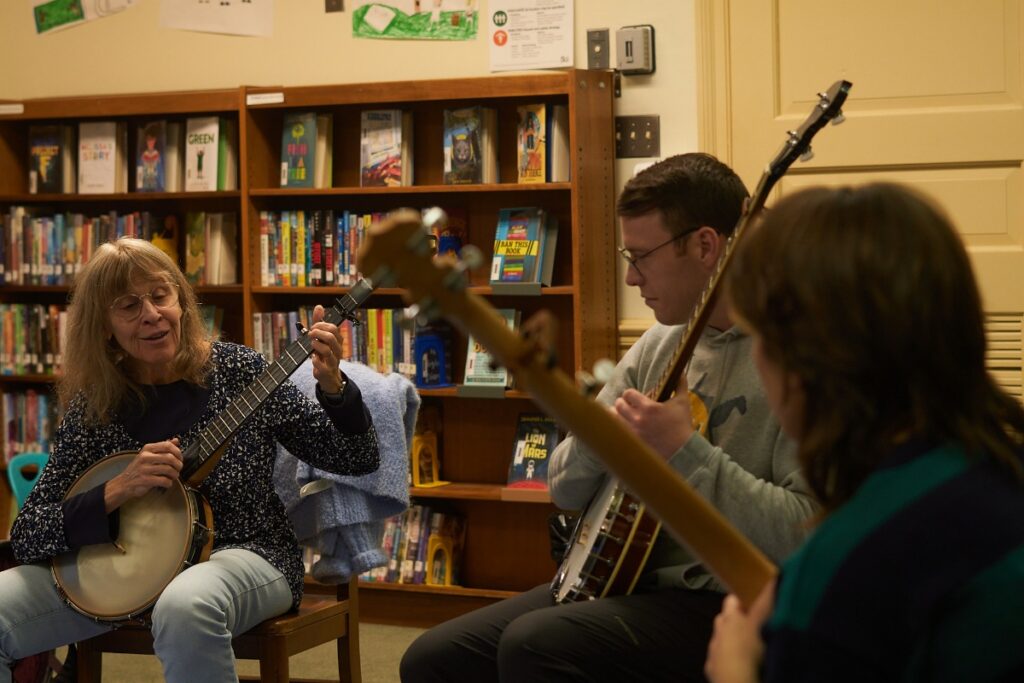
Over the years, its school has taught some 8,000 students, offering classes in fields from banjo to uilleann pipes at Winchester Thurston School. Education remains one of Calliope’s primary missions. The organization also supports a number of local jam sessions, including bluegrass, old-time music, ukulele and folk-song singing.
But live performances keep Calliope humming. Calliope features three distinct series a year: its main-stage series at the Original Pittsburgh Winery, intimate shows at the Roots Cellar and concerts under the tent at Schenley Plaza. A new partnership with the Pittsburgh Parks Conservancy also brought Calliope-booked artists to city parks for the Parks on Tap happy-hour series.
And lest you think folk is all kumbaya, Calliope’s performances extend beyond traditional acoustic sound. “We define folk music very broadly,” Bonavoglia says.
“Folk music today tends to be kind of a fusion; you will hear traditional sounds with traditional instrumentation, but musicians are creative people and they’re always looking to create something that’s unique.”
Creating a Home for Musicians
At its core, supporting musicians has always been central to Calliope’s mission. Not only did it provide shelter and a stage at the original North Side Victorian, “Calliope actually created the Roots Cellar,” says Bonavoglia. Located in the basement of the Marshall Building — the massive structure on the corner of Shady and Fifth avenues in Shadyside, formerly home to the Pittsburgh Center for Arts & Media — the Roots Cellar has been a home for Calliope’s shows for more than 20 years.
“Calliope made capital improvements to the basement. We purchased the stage, the furniture, the sound dampening panels, curtains to cover up the mirrors, sound equipment, lighting.”
Voilà — the musicians had a home. While the Marshall Building has been closed to the public in recent years, Calliope has remained on the docket and has a verbal commitment for its 2026/27 season.
New for this year, Calliope is planning a series of professional development workshops for local musicians who want to elevate their professional careers. “We’ll have workshops on budgeting, marketing and how to release music — and how to get gigs … those kinds of behind-the-scenes [skills] that no one really necessarily teaches.”
It’s another way that Calliope shows its support for local musicians — and continues to strengthen Pittsburgh’s creative community.
“You know when you drop a stone into the water and it ripples outwards? That’s how we think about our impact.”
Story by Lauri Gravina
Photos Courtesy of Calliope House Pittsburgh