
Carnegie Mellon University observes its 125th anniversary in fall 2025, its stellar achievements world famous. But one area of excellence tends to fly under the radar: CMU is a world epicenter of bagpiping.
Carnegie Mellon University’s Scottish Bagpipe Legacy
Carnegie Mellon University established the first academic bagpiping program in the world. Then schools in Scotland followed suit.
That is so CMU.
Carnegie Mellon sets the pace for excellence in most everything it touches, from groundbreaking research in technology and AI, to multidisciplinary innovations, to a focus on entrepreneurship, to 21 Nobel Prize-winning alumni and faculty and 66 Tony awards received by School of Drama graduates. It is a place where people can follow their passions and obsessions.
That is so CMU.
CMU students and alumni might not be able to define that catchphrase with scientific precision, but they know when something feels CMU-esque: An unequivocal standard of excellence. Unconventional. Quirky. The relentless drive for perfection. “My heart is in the work,” as Andrew Carnegie said.
As the university celebrates its 125th anniversary in November during homecoming weekend, with a slate of events that includes a Tartans football game and alumni awards, “that’s so CMU” will likely be uttered often —particularly when CMU’s Pipes and Drums perform.
The renowned pipe band is led by Andrew Carlisle. An internationally acclaimed and award-winning bagpiper from Northern Ireland, he has been a professor of music and the director of bagpiping at CMU since 2010.
Scottish Heritage and Bagpiping Tradition
The university displays several symbols of Scotland, in a nod to its Scottish immigrant founder. They include the original yearbook, The Thistle, named for the national flower of Scotland; The Tartan, the student newspaper; the Kiltie Marching Band; the Carnegie tartan pattern visible across many university traditions; and Scotty, the official mascot (who is, of course, a Scottish Terrier).
But it was not until 1939 that bagpiping arrived at CMU. Lewis W. Davidson, a native Scot, became the university’s first bagpiping instructor. Davidson’s original bagpipes are still on display at the School of Music.
From Extracurricular to Degree Program
Back then, says Carlisle, the bagpiping offerings were more of an extracurricular activity, with students learning to play the bagpipes for various events. That changed in the mid-1980s when Jimmy McIntosh came to town to instruct the CMU pipe band program.
“He was one of the top instructors and players in the world at the time,” says Carlisle. Supported by music faculty members, who appreciated the complexity of the instrument, the idea was put forward to start a degree program in bagpiping. The university embraced the idea.
The program was initially registered in 1990. It became the first in the world where one could study for a degree in bagpiping. (To be precise, the degree is in music — those who major in bagpiping have the same requirements as other music majors, but the bagpipe is the principal instrument for one’s degree.)
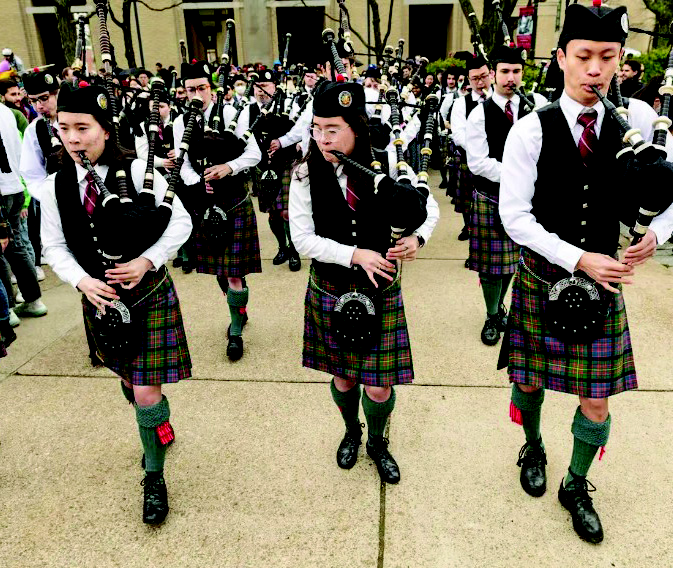
CMU Pipes and Drums Ensemble
Together with McIntosh, Carlisle started a master’s program for bagpipe performance in 2011.
Only a handful of students are majoring in the program at any given time. “You have to be pretty excellent to be able to get in,” says Carlisle. Today, a number of graduates lead other bagpiping programs that have cropped up after CMU blazed the trail.
It only followed that a pipe band would emerge out of a university with a bagpiping major. The pipe band program is also a registered class. “Anyone who is a student at CMU can take the pipe band as an elective class and can get academic credit for playing in the band,” says Carlisle.
Pipes and Drums is predominantly composed of CMU students and alumni and is, unsurprisingly, one of the most accomplished bands of its type. About 50 pipers and drummers make up the band. Not only do the Pipes and Drums play at CMU campus-wide events, but they are a presence throughout Pittsburgh and on the national — and lately international — stage.
Performances and International Competitions
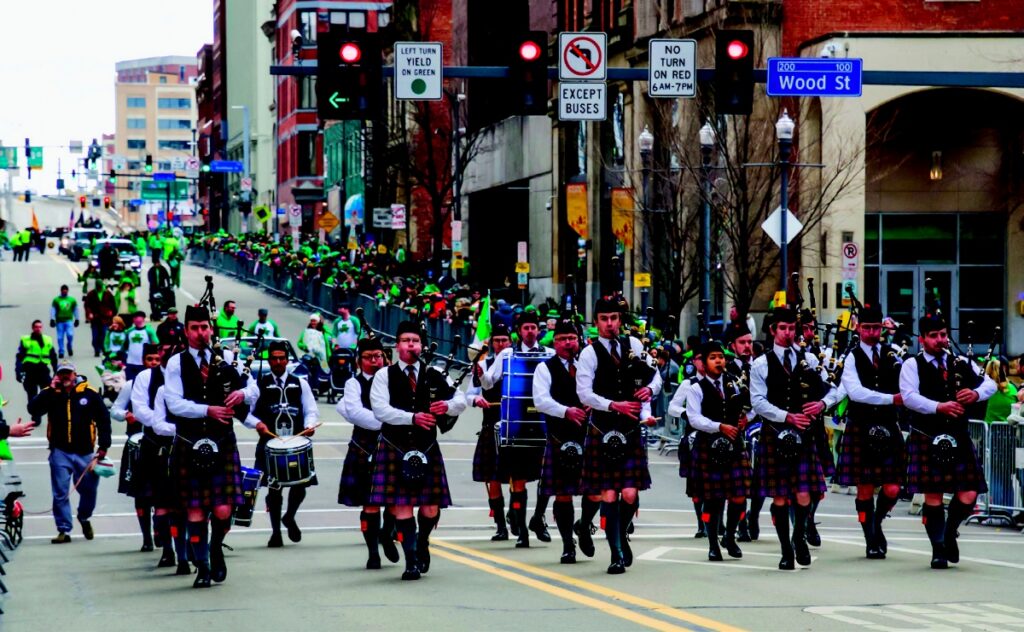
Locally, they regularly play at the St. Patrick’s Day parade and appear with the River City Brass for its Celtic Connections concerts. But there are not a lot of places that can accommodate bagpipe concerts. Keep in mind, the instrument was originally intended for carrying sounds across vast spaces, like a battlefield; a collection of bagpipers is accordingly loud. Competitions are one of the primary platforms for a pipe band ensemble.
The band has won countless first-place awards in competitions. This year, it took top honors at the Scottish Festival & Highland Games in Chicago and the American Pipe Band Championship in Norfolk, Virginia.
“The band’s gotten better and better over the years and has grown in numbers and in quality,” says Carlisle. “This year is exciting because for the first time, we’re taking the band to compete in Scotland.”
The competition, the World Pipe Band Championships in Glasgow, was held August 15-16. The CMU band placed fifth in its division. It followed the band’s performance in the European Pipe Band Championships in Perth, Australia on Aug. 9, where they took second place in their division, competing against 14 other bands. There is a Pittsburgh piping presence outside of CMU: the Pittsburgh Piping Society, of which Carlisle was a founding member.
“There have been bagpipers for a long, long time in Pittsburgh,” says Carlisle. “Certainly, in the last 15 years, there has been a big resurgence in people playing it, and I think CMU and the Pittsburgh Piping Society have been instrumental in that.”
While bagpiping is now an ingrained part of the school’s culture, it fits right in not just because of the Scottish association but because it is so CMU: Challenging to learn. Difficult to master.
Nonstop Innovation
The overall theme of CMU’s 125th anniversary is “125 Years of Innovation.”
“There are so many things we’re looking back on, but we are placing equal emphasis on CMU’s impact into the future,” says Teresa Trombetta, assistant vice president for alumni and constituent engagement. “We’re taking a very forward-facing look at what is to come in higher education.”
At the celebration, alumni awards will be presented. In fact, this year is the 75th anniversary of these awards, which honor the university’s most exceptional alumni community members. A Founders Medal, the highest alumni honor, will be given at the ceremony.
“I think one of the things CMU does best is to bring together people with really diverse and incredible talents but to address the most complex issues facing our world, and I think one of their biggest strengths is their interdisciplinarity,” says Trombetta.
The bagpiping program, in Trombetta’s eyes, embodies a spirit of connection and pride. “It’s part of our fiber and part of our history and something we are really proud of.
“When you hear the bagpipers, it adds an element of deeper meaning to things,” she says. “In many ways, the bagpipes are so CMU.”
How Hard Is It to Play the Bagpipe? Ask Walt McGhee

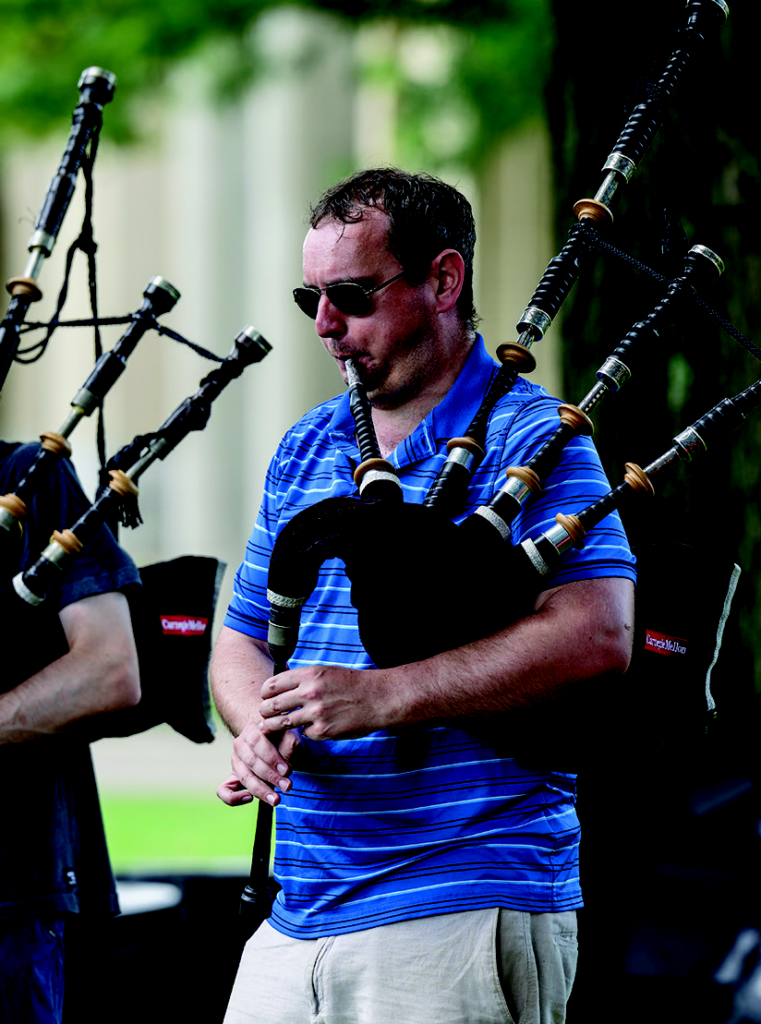
Walt McGhee, a member of Carnegie Mellon Pipes and Drums, started to play bagpipes about eight years ago. It has not been an easy journey.
“I wanted to learn a few tunes to amuse my friends,” says McGhee, a retired financial professional from Fox Chapel. “My ‘parlor trick’ turned into a way of life. Whatever the reason, piping took hold of me entirely.”
McGhee, who has Scottish heritage, has always loved the sound of the bagpipes. He studies privately with CMU’s Andrew Carlisle and others.
“I did it the way I normally do things — I dove right into the deep end,” McGhee says. “To play a bagpipe is physical. It takes lip and arm strength and finger dexterity. You have to memorize all the music.” Daily practice is essential to keep up skills.
“Whatever progress I’ve made, I owe to Carnegie Mellon and my private tutors. The piping community is welcoming, albeit somewhat unique. After all, when you join a group of people who enjoy making loud music, you become one of the characters.
“To my relief, I’ve noticed that many people listen with their eyes,” McGhee says. “They seem to get a real kick out of seeing a man dressed in a kilt. It’s a cultural thing — performing and playing bagpipes is a nod to Scottish Highland culture, and we’re trying to keep that alive.
“I am told that it takes seven years of study to become a piper. I am in year eight but still playing the ‘third chair’ as it were, always trying to make the grade.”
Story by Hilary Daninhirsch