
At Lawrenceville’s community gardens, residents put their green thumbs to work boosting food security while building social bonds. Two micro-farms and an orchard dot the dense urban landscape, yielding fruits, vegetables and herbs for the volunteers who tend them — and for neighbors in need.
Lawrenceville’s Community Gardens Help Citizens and Volunteers Alike One Sprout at a Time
Lawrenceville Organic Community Garden took root nearly 20 years ago in Allegheny Cemetery and has since grown to include a pair of small-scale agricultural operations, one at Duncan Avenue and another at McCandless Avenue and Natrona Way.
The resident-run program receives fiduciary oversight from Lawrenceville Together (formerly Lawrenceville United) and support from an array of partners, including Grow Pittsburgh, Tree Pittsburgh and the Giving Grove, a national nonprofit that promotes the planting of fruit and nut trees and berry brambles in municipal environments.
“We believe everyone should have access to fresh, healthy produce,” says Emma Gamble, Lawrenceville Together’s community engagement and program manager, who notes that the gardens were started when parts of the neighborhood were government-designated food deserts. Despite its growth, Lawrenceville is not a uniformly affluent neighborhood. The core mission of the gardens — fostering sustenance and sociability — remains unchanged.
Supporting Food Security in Lawrenceville
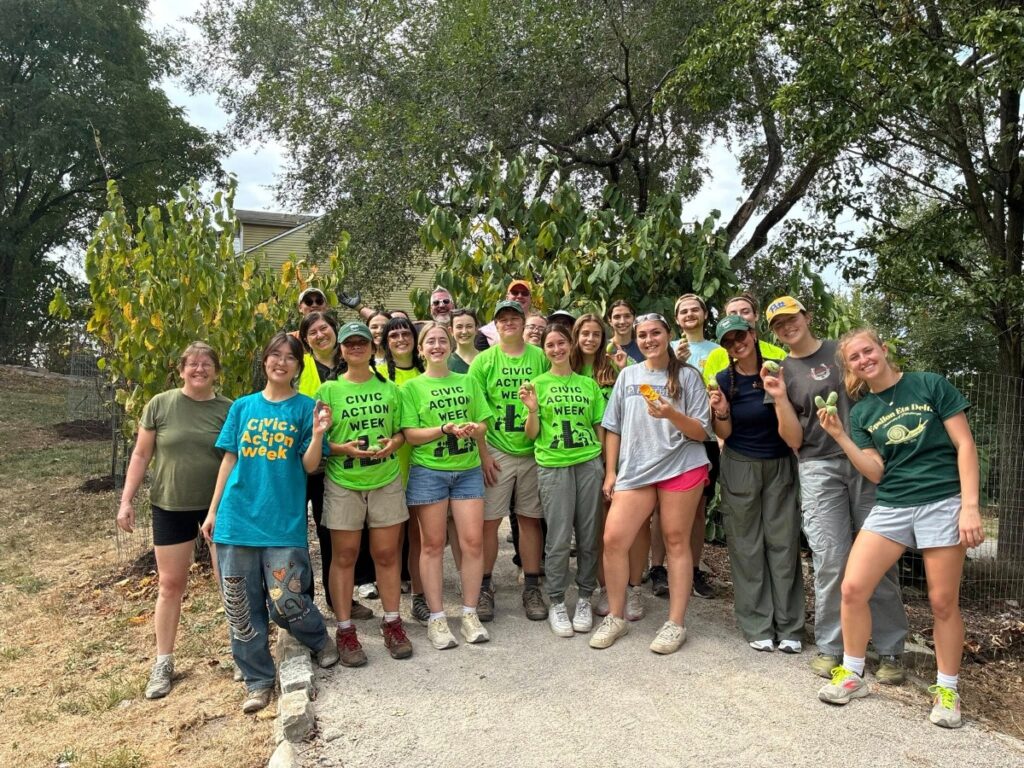
Gamble stewards the Duncan Park food forest, a decommissioned city playground that supports dozens of trees and fruiting shrubs: pawpaw trees, apple trees, blueberry and jostaberry shrubs, a strawberry patch, an herb spiral and more. A block long, it also contains picnic tables, benches, a basketball court and slides. Fruit at Duncan is available to everyone, including passersby.
McCandless Park Community Garden
A few blocks away, at McCandless Park, veggies are the focus; the bounty is free for the taking there, too. “Food is food. Vegetables are easy to grow. We don’t have to protect them in any grand way,” says McCandless steward Mark Drummond, an upholsterer by trade.
“Most people are respectful, taking just what they need. They might send their kids for a bunch of radishes or some lettuce when they’re making dinner.”
The occasional surplus crop is typically donated to Lawrenceville Together’s weekly food distribution program to augment the bread and other groceries local businesses contribute through 412 Food Rescue.
“We deliver boxes to people in the neighborhood,” Gamble says. “You don’t need to be income qualified. All we ask for is your address and whether you have food allergies or preferences.”
Volunteers Behind Lawrenceville’s Community Gardens
All gardens are managed by volunteers who gather twice weekly, cultivating camaraderie while they sow, water and weed. Hundreds of folks, including some from outside Lawrenceville, have pitched in over the years.
Jesse Perkins has helped lead efforts at Duncan since 2016, when he bought a house to rehab in the neighborhood. Although he now leases the property and lives in Bloomfield, he remains committed to the park and what he calls his “healthy hobby.”
“I like the exercise, learning about different plants — and helping beautify a public amenity for the community,” says Perkins, who works as a general contractor. “But it’s maintaining connections with friends and making new connections with like-minded neighbors that keeps me coming back.”
Artist and designer Leah Patgorski has maintained ties to McCandless Park despite moving to Shadyside. “When people come and say they appreciate the garden, I feel proud” to have helped create it, she says. “We’re making a little green space where people can hang — even if they’re enjoying it in a passive way, like reading a book.”
Also Providing Gardening Education
Novice gardeners are especially welcome; one of the goals of the program is to demonstrate “that growing your own food is normal” and eating a tomato nurtured from seed tastes like no other, Drummond says.
Decisions about what to plant are made by a core group of fewer than 10 volunteers; special requests are usually welcome. Experiments with wasabi and mustard were less successful than asparagus and rhubarb, which have thrived for 10 years. Benches were installed to beckon visitors, and crop plants are surrounded by annual and native ornamentals.
“We manage for aesthetics as well as food,” says Drummond. “At the moment, the garden is looking pretty smart.”
Environmental Benefits
Besides their immediate yield, community gardens benefit neighborhoods in other, transformative ways, according to Dora Walmsley, deputy director of Grow Pittsburgh, which supports similar endeavors throughout Allegheny County with in-kind services and material grants.
“They replace vacant, litter-filled lots with clean, inviting spaces,” Walmsley says. “Along with that, [they] help reduce crime and improve safety … Gardens increase property values and enhance the environment with climate resilience and biodiversity.”
Where the parks have native plants, there are butterflies, bees and other pollinators. For example, pawpaws are contributing to the survival of the zebra swallowtail butterfly, a species in decline. Pawpaw is the only plant that zebra swallowtail larvae can feed on.
At the End of the Day, It’s About Community
Urban mini-farms are also fertile ground for inclusivity and cultural exchange, says Deirdre Kane, steward of the Allegheny Cemetery plot. “We’re growing a community as much as we are a community of growers. You get to meet adults you might not otherwise cross paths with and expand your horizons. We’re not membership based, so as volunteers ebb and flow, so does our variety of crops.”
A Japanese couple introduced daikon radish, mizuna, komatsuna, Chinese cabbage, tatsoi and hakurei, a type of turnip that became a favorite of other gardeners, says Kane. “An Iranian woman who loved having access to fresh okra came with her daughters by bus.”
Because the cemetery garden is fenced against deer, it is not publicly accessible — but anyone who volunteers shares in the harvest, says Kane, who works in marketing for Highmark.
“We donate when we have excess or know of someone in need, but we mostly divide what we grow equally among ourselves.”
Story by Deborah Weisberg
Photos Courtesy of Lawrenceville Together