
Historic Oakland stands as one of Pittsburgh’s most significant neighborhoods, where landmark institutions, grand architecture, and a remarkable vision transformed rural farmland into a thriving cultural and educational center.
A History Lesson on Pittsburgh’s Oakland
Stand at the corner of Forbes Avenue and Schenley Drive and you’ll see all the movement of modern life: a steady flow of undergraduates, medical residents, museum-goers ambling up the steps of the Carnegie Museum of Art and tourists pausing to photograph the Cathedral of Learning. On a weekday afternoon, the sidewalks here rival those of any major American city. The neighborhood is Pittsburgh’s second downtown — and it’s home to two universities, world-class museums, one of the largest medical complexes in the country and much more.
It may be hard to imagine, then, that just over a century ago, this part of the city was farmland.
The transformation from cow pastures to cultural capital took place during roughly three decades at the end of the 1800s — and it happened largely because of an idea from an Ohio real estate developer.
The Visionary Who Died Broke
Franklin Felix Nicola (1860–1938) was a Cleveland businessman who arrived in Pittsburgh in the mid-1890s with a wild idea: Pittsburgh’s elite, choking on smog Downtown, would happily relocate their cultural and social lives to a clean, green district to the east. His vision started with the Hotel Schenley, which opened Oct. 1, 1898, on land Nicola bought from heiress Mary Croghan Schenley. It was Pittsburgh’s first skyscraper hotel: a marble-and-chandeliers affair that hosted Presidents Taft and Eisenhower, the founding dinner of U.S. Steel in 1901 and a 1959 speech by Nikita Khrushchev. Today, the building serves as the University of Pittsburgh’s William Pitt Union.
Nicola’s masterstroke came in the early 1900s, when he assembled a development group called the Bellefield Company. His stakeholders included virtually every big name in Gilded Age Pittsburgh, including Andrew W. Mellon, Henry Clay Frick, Andrew Carnegie, George Westinghouse and H.J. Heinz. After purchasing the last of Mary Schenley’s estate in 1905, Nicola unveiled a master plan for Oakland that included civic, social, residential and educational zones along Bigelow Boulevard.
The Beginning of Oakland’s Transformation
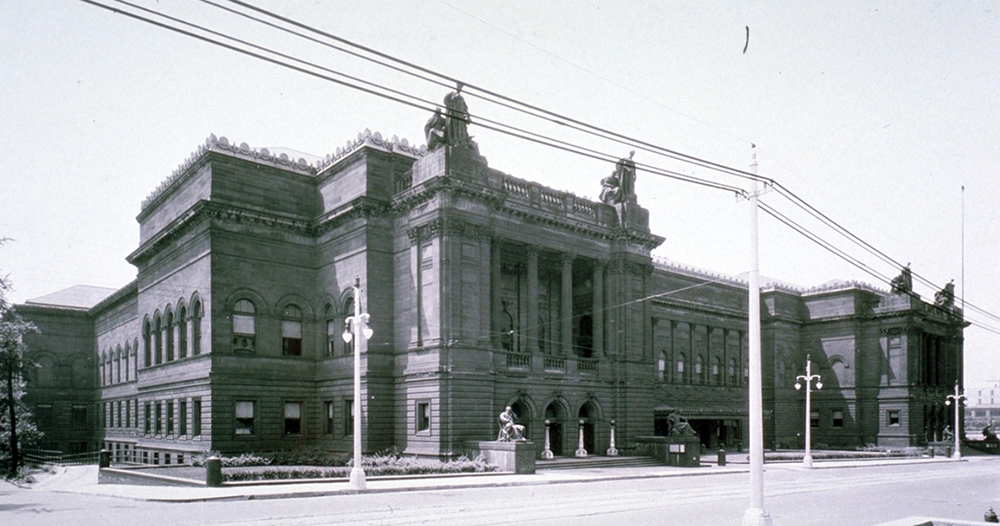
Over the next 20 years, Nicola’s plan came to life. The University of Pittsburgh and the Carnegie Institute of Technology (now Carnegie Mellon University) built their campuses on Nicola-developed land. Forbes Field opened in 1909. Soldiers and Sailors Memorial Hall, dedicated Oct. 11, 1910, anchored Fifth Avenue with Henry Hornbostel’s Greco-Roman colonnades and 150-foot pyramidal roof. The Pittsburgh Athletic Association rose between 1909 and 1911, and the Masonic Temple (now Pitt’s Alumni Hall), Bellefield Hall, the Twentieth Century Club and St. Paul Cathedral arrived during the same era.
For the residential part of his vision, Nicola commissioned local architects to design 96 model homes on flat ground and 39 more on a terrace above, all subject to design guidelines and equipped with underground electrical and telephone lines. (In 1906, when this plan was put into place, telephone lines were a genuinely radical amenity.) He named the streets for British and American literary figures: Parkman, Lytton, Tennyson and Ruskin. The houses are still occupied today.
What set Oakland apart from other developing neighborhoods like Cleveland’s Shaker Heights or the Main Line in Philadelphia was that it didn’t pull wealth out of the city and into the suburbs. Rather, it gave people a reason to stay in the city.
The Lost Pieces of Oakland
Not everything from Oakland’s first building boom survived. But the legacies have a way of resurfacing.
Forbes Field, demolished in 1971 after the Pirates moved to Three Rivers Stadium, lives on in fragments. The brick outfield wall in left-center field still stands along Roberto Clemente Drive, complete with painted home-run distances and a plaque honoring Bill Mazeroski’s 1960 World Series-winning homer. Home plate from the final game is preserved in glass on the first floor of Pitt’s Posvar Hall, which now sits atop the old infield. Every Oct. 13, a group called the Game 7 Gang gathers at the wall to listen to a recording of the 1960 broadcast — a tradition started by a single fan in 1985.
Luna Park, the dazzling 16-acre amusement park lit by 67,000 electric bulbs that once sat at Baum Boulevard and Craig Street, lasted only from 1905 to 1909 before bankruptcy and competition ended its run. Today, no remnants remain on the original site. However, in 1995, Kennywood opened its “Lost Kennywood” section, which includes a recreation of the original front gate, down to its pre-1911 spelling: “Welcome to Luna Park, Pittsburg.”
Panther Hollow Lake, built between 1907 and 1909 by damming Four Mile Run, still sits in Schenley Park beneath the spectacular 1897 Panther Hollow Bridge, with four bronze panthers designed by Giuseppe Moretti watching over the entrances. The 1909 boathouse is gone, demolished in 1979, and the lake itself is silted in and largely unusable. But the bridge remains one of Pittsburgh’s most photographed landmarks.
The Legacy of Franklin Felix Nicola
Nicola died nearly bankrupt in 1938, his real estate empire wiped out by the Depression.
But many of his original buildings and boulevards — as well as the idea that residential space could be integrated into a walkable district with civic and educational areas — survive in Oakland to this day.
Few American cities owe so much of their identity to a man whose name appears on none of the buildings he envisioned. The next time you’re in Oakland, consider the man and the 1905 plan that made it all possible.
Story by Kenny Gould