
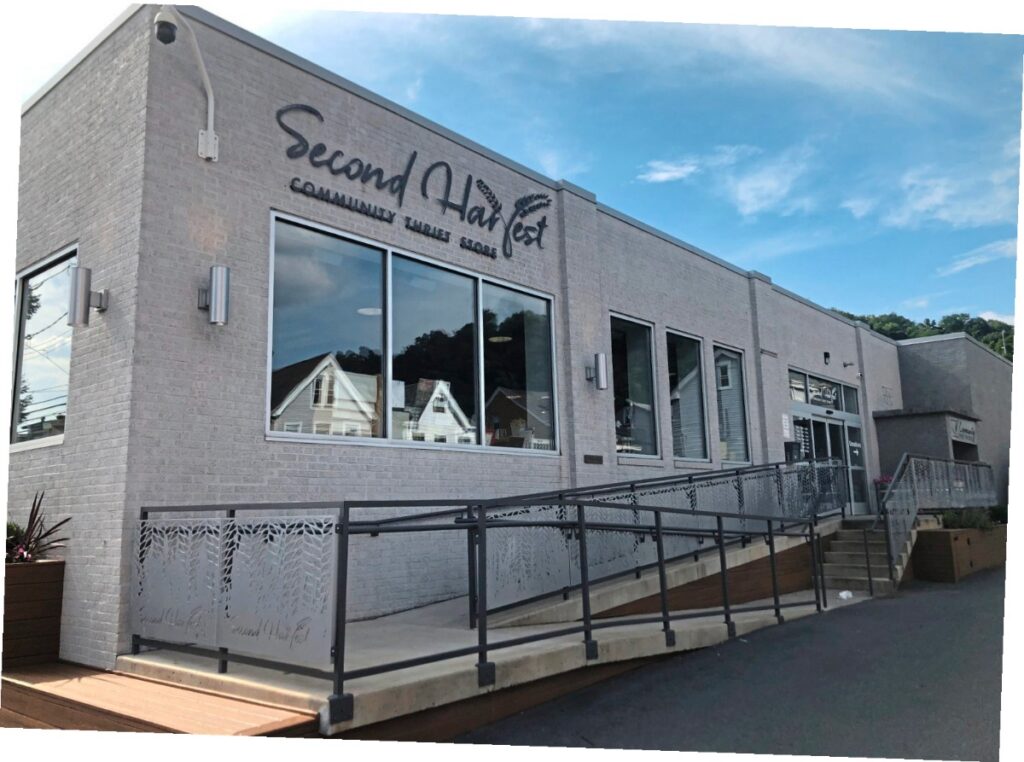
On the corner of Eighth and Clay in Sharpsburg, a sleek storefront hums with life. The 6,500-square-foot space, once a forgotten building, is now filled with sunlight, secondhand treasures, and something harder to define but instantly felt: a spirit of welcome. This is the Second Harvest Community Thrift Store, and at its heart stands Executive Director Bonnie DeMotte.
Second Harvest Community Thrift Store
The story of Second Harvest is part mission, part miracle. What began as a conversation between DeMotte and her pastor at Fox Chapel Presbyterian Church soon grew into a communitywide movement to meet material needs and, just as important, foster relationships across socioeconomic divides.
From raising $2 million in just 14 months to navigating construction during a global pandemic, DeMotte has guided Second Harvest from concept to cornerstone. The store is more than a place to find affordable goods; it is a gathering space, a social hub, and a springboard for change. With a new grocery initiative underway and more grants being reinvested in the neighborhood, Second Harvest is just getting started.
DeMotte talked to Shady Ave about Second Harvest’s journey, the community that made it possible, and some surprising items that have come in for donation.
Origin of Second Harvest
Tell us the origin story of Second Harvest and its connection with Fox Chapel Presbyterian Church.
Second Harvest began from a conversation I had in 2018 with our pastor at the time, the Rev. Chris Taylor, about dreams for the church and how it might grow. I told him I wanted to build relationships in Sharpsburg. The Fox Chapel Area School District includes six distinct municipalities, with Sharpsburg and Fox Chapel at opposite ends of the resource spectrum. All the kids attend the same schools, but there are often few opportunities for relationships to form across those communities.
Our church has an incredible 50-year tradition called Harvest Fair — the community donates goods, we hold a two-day sale, and all the money is given away. In the summer of 2018, the St. Vincent de Paul thrift store in Sharpsburg — which had served the community for decades — closed. That left a real void.
So we had this desire to build relationships, a tradition of selling donated goods and giving the proceeds away — and now a need in the community that wasn’t being met. That’s really where it all began.
What accelerated the idea was that a member of the church, Wilma Stoebener, had passed away and left a gift designated for “the care and support of the local indigent.” As a church, we knew we didn’t want to own real estate or run a business. It quickly became clear that we needed to establish a separate nonprofit.
I began approaching people to serve on the board and reached out to other faith communities, as we wanted this to be a true community asset, not a program of Fox Chapel Presbyterian Church.
Biggest Challenge During Building
For two years, you juggled planning, fundraising, and construction. What was the biggest challenge you faced in bringing Second Harvest to life, and how did you get through it?
The largest challenge was the pandemic, as every aspect of it, including fundraising and construction, was impacted. We had a great plan for how we were going to raise this money, but it quickly pivoted to 50 one-on-one coffees at Panera, rather than a more traditional fundraising path. The same was true for construction, with all kinds of delays and unavailability of resources, among other issues.
Honestly, I think we were better for it because it gave us a little more time. It helped us tell the story of why there was such a great need and connect with many people individually, who not only contributed to the capital campaign but continue to donate to us to this day.
Vision of the Community Space
How did you shape the broader vision of Second Harvest serving as a gathering space and a social support hub?
It goes back to relationships. From day one, we said that if we were just a thrift store, we weren’t fully meeting our mission. We wanted to meet both material and relational needs. Connecting people, building trust, and responding to what we saw — that was always part of the plan.
Dignity and Design
You’ve spoken about wanting people to “shop with dignity and choice.” Elaborate on why this principle is so important. And how does the building itself elevate the shopping experience?
Dignity and choice are huge pillars for us. Some thrift stores use voucher systems, which often carry a stigma. We didn’t want that. If someone is in need, they receive a gift card, just like you’d give someone for the holidays. Everyone shops the same way. You can go in and choose the style you like, which makes for a better experience all around for the people we’re trying to serve. It’s anonymous, respectful, and empowering.
Our architects, Rothschild Doyno Collaborative, really understood what we were trying to create. Whether you need to shop here or just want to, it’s a beautiful, bright, modern space. That design says a lot about how much we value our shoppers.
Remedying Food Insecurity
Was it part of Second Harvest’s original mission to be involved with food insecurity in the community, or did that evolve as you saw the need?
It wasn’t part of our original plan. But during the pandemic, the need for food access quickly became urgent. Grocery affordability changed dramatically, and we saw that right away. We had opened to meet needs like couches, clothing, and shoes, but it became clear quickly that food was also a huge issue.
About a year after we opened the thrift store, we launched the Community Free Fridge, and that program has continued to grow year over year as the need for immediate hunger relief has increased. The community has embraced it in the same way they embraced the store. People stock the fridge and they drop off food when they bring clothing donations. It’s become a natural and essential part of what we do.
Refugee Support Story
You’ve partnered with programs like Hello Neighbor to support refugee families. What’s one story from that partnership that stayed with you?
The one that tugged at my heartstrings was an Afghan sibling group who arrived about two and a half years ago, just before Christmas. They had absolutely nothing and ended up filling a U-Haul with couches, clothing, coats, shoes, and a Christmas tree.
But what meant the most to them was a little snow globe that played I’ll Be Home for Christmas. They were so excited about it, and when the music started playing, we all started crying. That moment captured exactly why we’re here — to help people turn an empty space into a home. The snow globe was just the icing on the cake.
Future Plans
There’s a capital campaign launching this fall and a new grocery/market concept in the works. How are you envisioning Second Harvest’s next chapter?
I see this as a natural extension of our original mission: to meet material needs while building relationships. We started with clothing, shoes, and couches, and now we’re expanding into access to affordable, nutritious groceries. It’s still completely aligned with our core purpose, just an expansion of our programming.
We’re focused on educating the community about the need and showing them how they can help meet it.
Career Path
Tell us about your career path and how it led to Second Harvest.
My career path has been circuitous. By training, I’m a chemist. I worked at PPG and Merck before semi-retiring to raise our five children. I was out of the workforce for a long time while they were young.
During that time, while my kids were playing sports, I saw firsthand the need in Sharpsburg. I was driving kids home to Sharpsburg from football and baseball practices because they didn’t have rides. Sharpsburg is a community in which almost 25 percent of families do not have personal transportation.
In many ways, my kids opened my eyes to the diversity in our district. I started learning more about the partnerships and programs already happening in Sharpsburg, and getting involved made me realize just how great the need was in my own backyard. From there, it felt like I was in the right place with the right skill set to make an impact.
Motivation and Purpose
What drives you on the hard days?
Energy and optimism are natural strengths for me. On tough days, I remind myself why we’re doing this. When I’m deep in permits and paperwork, I think about the people we serve and the impact we’re having. That always brings me back.
What do you enjoy most about working in Sharpsburg?
Sharpsburg has incredible pride. Most residents have lived here their whole lives. There’s deep community involvement, especially at the council level. It’s a unique town with a lot of potential, and we’re committed to keeping it affordable for the people who’ve called it home for generations.
For a first-time visitor to Second Harvest, what’s the one thing you want them to notice as they walk in the door?
People always say, “This doesn’t look or smell like a thrift store.” That’s exactly what we want. It should feel like walking into a boutique — organized, clean, and dignified. That experience matters.
Ideal Day Off
Let’s say you have a completely free Saturday. What does your ideal day look like?
Tennis, golf, time with my husband and kids, and probably a stop at a thrift store. It’s in my blood.
What are some of the more unusual items that have come in for donation?
That’s one of the fun parts of the job. You never know what’s going to come through the door. Every day is different. We’ve had some amazing high-end items, like antique tobacco pipes, gold and diamond jewelry, and silver bowls. And then we encounter unexpected things, such as antique Japanese miniature hibachi grills. The variety of donations is fascinating.
You’re at a thrift store in another city. What’s the one thing you’re always hunting for?
I have a few random grails, but I’m always on the lookout for vintage Ghurka bags by Marley Hodgson. They’re super niche — classic American leather — but I did find one once!
624 Clay Street, Sharpsburg
Story by Daniel Casciato