On August 1, more than 200 artists and 75 bands will transform Butler Street into one of Pittsburgh’s most energetic open-air festivals: the Lawrenceville Art Crawl.
Lawrenceville Art Crawl 2026
Butler Street doesn’t need much help drawing a crowd on a summer weekend. Coffee drinkers spill onto cafe patios, shoppers drift between boutiques, and the bass from nearby bars leaks onto the sidewalk.
On the first Saturday of August, the street transforms entirely.
Painters set up easels along the curb. Jewelry makers spread handmade pieces across folding tables. Bands test microphones outside neighborhood bars while food trucks idle nearby. Somewhere in the crowd, someone hands a stranger a paintbrush and invites them to add a few strokes to a giant communal canvas.
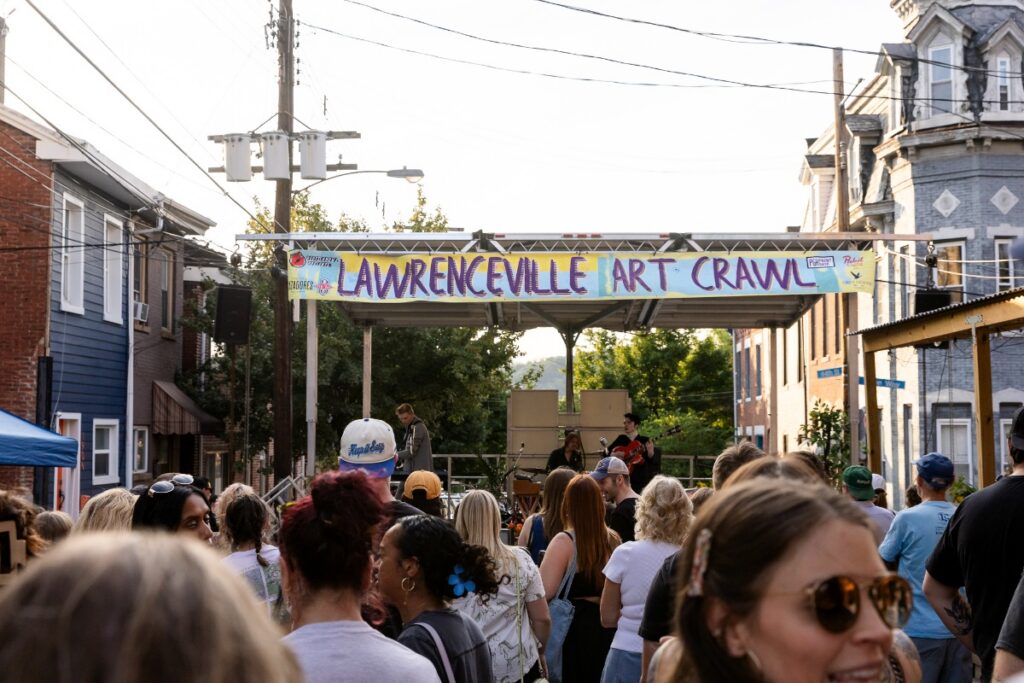
That is the Lawrenceville Art Crawl, returning August 1, when more than 200 artists, 75 bands and performers, and dozens of businesses will turn Butler Street into one of Pittsburgh’s largest open-air art festivals.
The event stretches (roughly) from 37th Street to 50th Street, drawing close to 10,000 visitors each year.
“It’s a great day for businesses and artists,” says Chris Boles, founder of Redfishbowl Studios, the Lawrenceville-based artist collective that organizes the event. “There’s a lot of foot traffic and a lot of people discovering new work.”
Unlike more traditional art festivals tucked into parks or plazas, the Art Crawl happens across the neighborhood itself. Visitors wander Butler Street the way they might wander a museum — except the exhibits are spread across a dozen city blocks and the soundtrack includes live bands, DJs, and street performers.
Participating Venues and Performance Stops Along Butler Street
Stops along the crawl often include venues such as The Abbey, Thunderbird Music Hall, Spirit, The Goldmark, Bar Botanico, New Amsterdam, and Blue Moon, each hosting performances, installations, or pop-up shows as crowds move steadily between them.
Certain intersections naturally become crowd magnets. 44th Street and 46th Street typically close to traffic and turn into dense festival zones with vendors, temporary bars, and pop-up stages. Between those points, Butler Street becomes a slow-moving river of people.
Interactive Art Experiences and Community Participation
Part of the crawl’s appeal is the event’s combination of a traditional art market and a hands-on experience. Visitors can browse paintings, ceramics, and handmade jewelry, but they can also participate directly. One returning feature is an 8-foot community canvas, hosted by an artist — anyone walking past can grab a brush and contribute.
For artists, the event offers direct access to thousands of potential buyers in a single day. Some leave with dozens of sales, while others gain followers who later commission work or attend gallery shows. “It kind of depends on what they’re selling,” Boles says. “Jewelry versus paintings, price points, size, etc.”
Featured Artist Spotlight: Nikki Peña
Pittsburgh artist Nikki Peña, who works primarily in acrylic painting and pyrography, participates both as an independent artist and as a member of Redfishbowl Studios.
“I’ve been a member of Redfishbowl for about four years, and I’ve always done this event because it’s one of my favorite ones,” Peña says. “It’s kind of our big flagship event.”
During the crawl, Peña sells original paintings, prints, and woodburned pieces inspired largely by nature and animals. Artists typically set up outside participating businesses along Butler Street, turning sidewalks into temporary galleries.
But with thousands of visitors moving through Butler Street over the course of the day, the exposure alone can be significant. Peña says artists often see themselves as part of the neighborhood ecosystem rather than simply vendors setting up shop.
“We always try to be respectful of the storefronts,” Peña says. “If people ask where to eat or get coffee, we recommend the businesses we’re set up in front of. It’s definitely about the art, but it’s also a community event.”
Business Participation
For many venues along Butler Street, the crawl has become one of the busiest days of the year. At Blue Moon, the longtime LGBTQ+ bar on Butler Street, the event has long been part of the calendar.
“We’ve been involved since the very first year in Lawrenceville, since 2017,” says Alistair McQueen, a former employee and artist who has helped coordinate the bar’s participation.
The bar opens earlier than usual during the crawl to accommodate the crowds moving through the neighborhood.
“The bar will already be close to capacity by 4 or 5 in the afternoon,” McQueen says. “It definitely brings a lot of money into the bar every year.”
The atmosphere feels different from a typical weekend night, he adds.
“The Art Crawl is always so busy … There are thousands of people up and down the street. It’s really magical.”
Growth of the Lawrenceville Art Crawl and Its Impact
Boles organized an art crawl in South Side around 2016 before relocating the event to Lawrenceville in 2017. The growing arts and nightlife scene in Lawrenceville provided fertile ground for expansion.
What started as a homegrown gathering has since grown into one of Pittsburgh’s most visible arts events. Looking back, Boles still describes its beginnings with a mix of humility and surprise.
“Honestly, it started very organically, as an accident out of pure passion,” he says. “There wasn’t really a business element driving it.”
As Lawrenceville evolved into one of the city’s busiest corridors for dining and nightlife, the crawl expanded alongside it. For Boles, the event now helps preserve the creative identity that helped define the neighborhood in the first place.
“It keeps the area active and keeps it a consistent creative hub,” he says. “People go to the same venues, the bands play in the same places, and it reinforces that grassroots artistic footprint.”
Story by Aakanksha Agarwal
Photos Courtesy Redfishbowl Studios