
Essie Blader founded Pittsburgh Tutor in her Point Breeze apartment. Ten years later, it’s going strong in a Regent Square office, with a team of 35 tutors: ‘We reframe how students view themselves as learners.’
How Pittsburgh Tutor Grew Into a Business
The teaching profession found Essie Blader while she was riding the New York City subway.
Blader graduated from the University of Pittsburgh in the early 2000s with a B.A. in English literature and no firm idea what she wanted to do next. A native of Princeton, New Jersey, she went home to figure things out.
One day, traveling to Brooklyn to see her sister, Blader took the F train. A subway advertisement stared her in the face. “What do you call a room of authors, inventors, and explorers?” she recalls the ad asking. “Your first period class.”
The next line used the imperative: “Become a New York City Teaching Fellow.” A light bulb switched on.
Becoming a Teacher in New York and Beyond
The NYC Teaching Fellows program was right up her alley, providing intensive training and a quick path to a teaching license. Blader enrolled in the program and soon began teaching kindergarten in the South Bronx while pursuing a master’s in education at Lehman College, also in the Bronx.
After her New York stint, she moved west and taught elementary school in Portland, Oregon. There, she developed a niche as a reading specialist. Working to get kids back on track with their peers, Blader found a passion for helping students overcome barriers to learning.
But she never forgot her undergraduate years in Pittsburgh, “the only place where I’ve ever felt completely at home,” she says. Yearning for the “laid back but urban” vibe, she returned in 2015.
Creating Pittsburgh Tutor
After spending 12 years in the classroom, she was ready to “carve out a different way” of educating kids. So, at two tables in the living room of her Point Breeze rental, Blader founded Pittsburgh Tutor in 2016. To complement her language arts skills, she recruited math teacher Carolina McVeagh.
Blader sent flyers to area schools and garnered interest from two preK-8 schools: Fox Chapel Country Day (now merged with Shady Side Academy) and St. Bede School, a Catholic K-8 in Point Breeze.
She drove to homes in Fox Chapel to tutor elementary students, some of whom remain clients today in their high school years. St. Bede students would walk to her apartment where, she says, “I tutored them in literacy and Carolina tutored them in math,” side by side at tables in the living room.
Her business began with just a trickle of clients. “It was so exciting when someone called. I felt so encouraged because I really wanted to make this happen,” says Blader. “There’s a real need for this type of academic support.”
Growing a Learning Space in Regent Square
Within a year, her dream of tailored, one-onone instruction looked viable enough that she rented a small office in a commercial building on South Braddock Avenue in Regent Square. She liked the combination of a homey neighborhood and proximity to the Parkway East, which made it easy for clients to reach their office.
“I slowly brought on a couple more tutors,” she says. “And then in time, I rented the second room — and then the third and the fourth rooms.”
Today, that cluster of rooms allows Pittsburgh Tutor’s 35 instructors to support hundreds of students in grades K-12 across all academic subjects. “We’ve developed a reputation among teachers, counselors, parents, and neuropsychologists in the area,” Blader says. “The business was built almost entirely by word-of-mouth … one client at a time, one relationship at a time.” McVeagh, the original math tutor, still teaches at Pittsburgh Tutor.
How Pittsburgh Tutor Helps Students Learn
In one kind of intervention, tutors help a student catch up to grade-level proficiency and then go further. “We can meet kids where they are instructionally and celebrate their successes along the way,” Blader says.
Pittsburgh Tutor helps students achieve these successes by addressing a variety of student needs: homework completion, organizational and study habits, test-taking strategies, and skill and confidence building.
The key goal is to “reframe how students view themselves as learners,” says Blader. “We target gaps in prerequisite concepts and skills and work to build a foundation.” Once a student believes they can learn, that transforms into an enduring truth for them. Pittsburgh Tutor builds its work on the “growth mindset” concept popularized by Stanford psychologist Carol Dweck.
Blader is no stranger to teaching teachers. In the latter part of her teaching career, she did double duty, both as a classroom teacher and a mentor teacher, helping other teachers strengthen their instructional practice.
Programs, Families, and the Pandemic Shift
The team at Pittsburgh Tutor is equipped to design programs for students who want a greater degree of challenge than their standard classroom assignments. They also help college applicants and adults with test prep, be that the ACT and SAT or a civil service exam, GED, or a specialized test like for a nursing or culinary program.
Students can use the service for a relatively limited engagement or come back through the years for support and skill building. Siblings often follow each other into Pittsburgh Tutor’s classrooms. “We get to know families quite well because it’s such a personal business,”
Blader says. “We are supporting kids in the most important ways.” Blader herself embraces the idea of being a lifelong learner and follows a regimen of “self-imposed professional education,” which she shares with her team to meet the array of needs her students might bring.
“I see myself as an advocate for all kids,” she says, citing the way they address sensory and other needs of neurodivergent students. “I want to engage around these topics with people who know more than I do so that I can continue to learn and better support our kids here.”
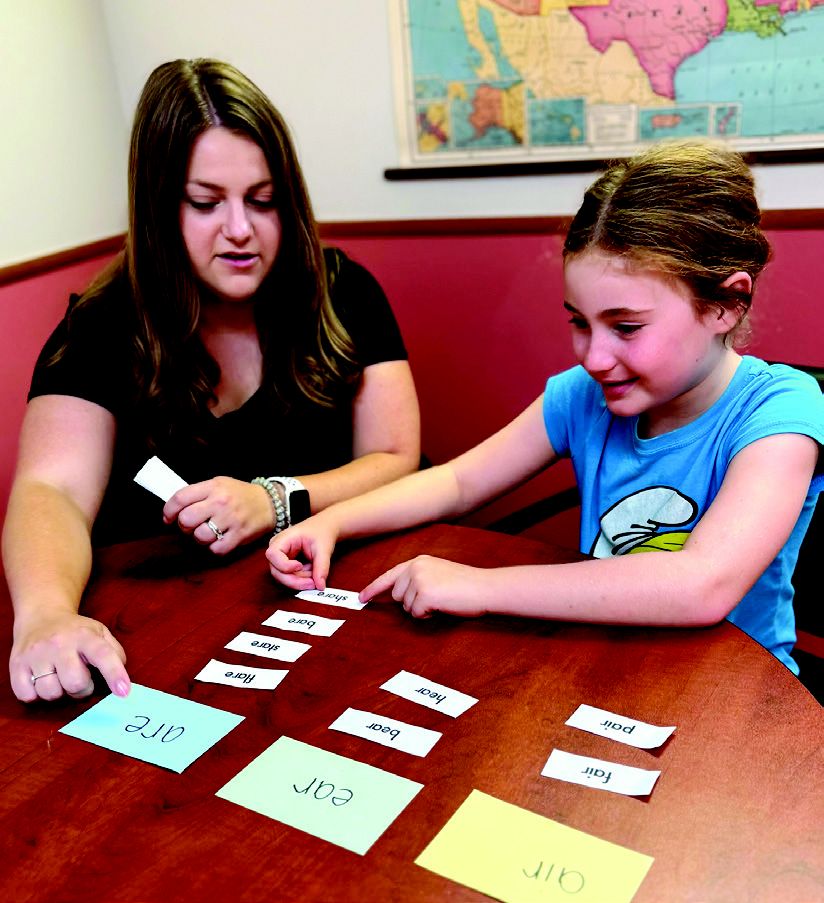
This one-on-one work leads to successes. Blader says client families share stories of “improvements at home, in their grades, outlook, and executive functioning.” Teachers also report the impacts of the business’s efforts back to the tutors.
Until the covid pandemic, tutoring was done in person. In the spring of 2020, Blader suddenly found herself digitizing all the materials. “It involved many long nights of compiling everything that was needed in a systematic way to be sent to clients,” she recalls. “For people who couldn’t print at home, I printed at the office and drove around to deliver materials.”
Although the core customer base resides in the East End and the Fox Chapel area, students come from across Allegheny County — “from Monroeville to the airport,” Blader says.
A Personal Connection to the Work
Online learning did not disappear when the pandemic eased. About half of the sessions still are conducted via videoconference. Pittsburgh Tutor has also expanded to include students — and tutors — from outside the region. Clients live as far away as Bermuda and the West Coast; the art tutor lives in California.
Blader now lives within walking distance of the office — where her son receives tutoring from one of her colleagues.
“I can confidently say that if I wasn’t personally affiliated with the business, I would definitely be a client,” says Blader, with a laugh, “which technically, I am!”
Story by Jeff Forster