
The Nationality and Heritage Rooms at the University of Pittsburgh are celebrating 100 years of honoring our city’s diverse immigrant population. And this December, a holiday open house features a gamut of multicultural activities, food, and entertainment.
Nations United Under One Roof
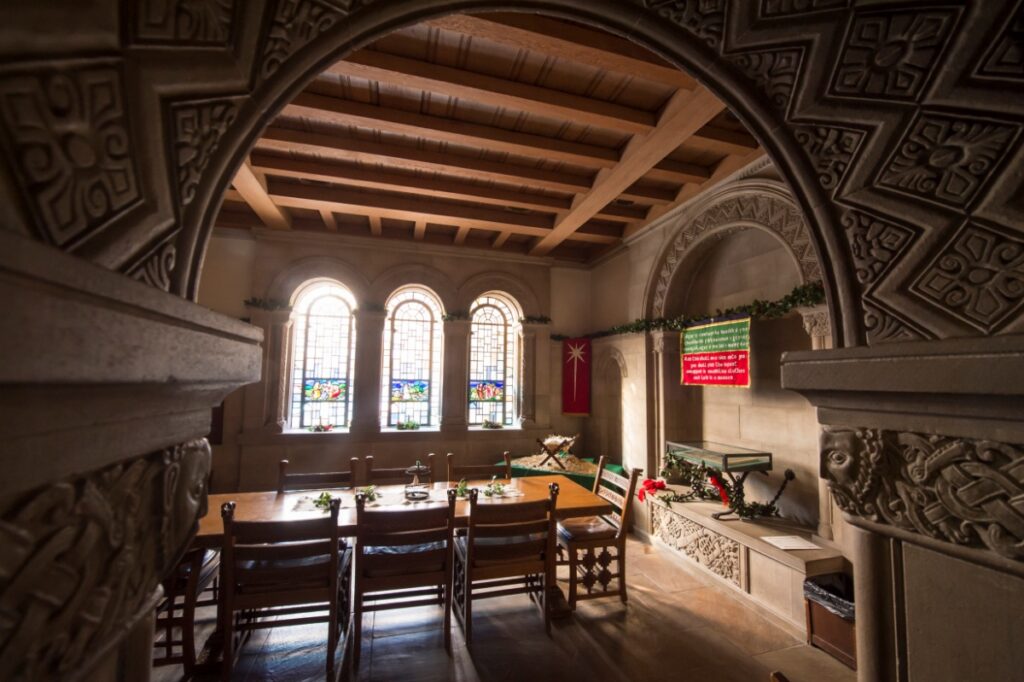
Visiting the University of Pittsburgh’s Nationality and Heritage Rooms, located on the first and third floors of the Cathedral of Learning, one discovers a trove of unexpected treasures: stained-glass panels that depict Grimms’ Fairy Tales; an illustrated replica of the Gospels from the Book of Kells; an Ekoi tribesman’s helmet mask carved from a single piece of wood and covered in antelope skin; a professor’s chair engraved with Chinese characters relaying Confucius’ words, “Teach by inspiring gradually and steadily.”
The museum-caliber rooms, now celebrating 100 years since their inception, embody a range of architectural and interior styles.
Beautiful Rooms from Around the World
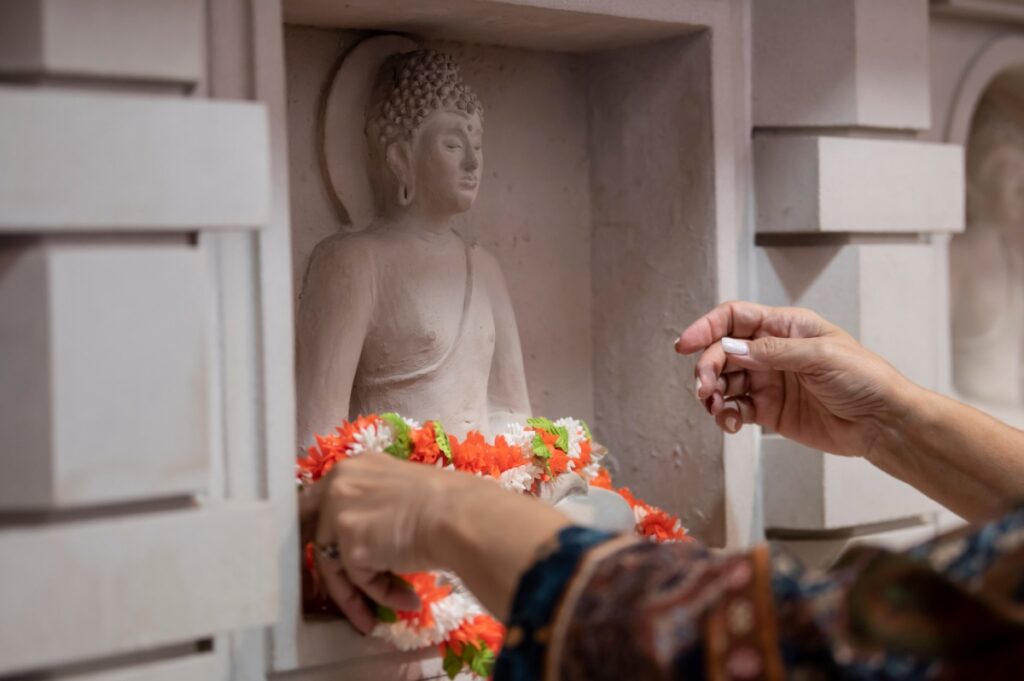
The opulent Austrian Room was modeled after a palace outside Vienna, with a crystal chandelier and red velvet chairs. Next door is the Japanese Room, modeled after a modest minka (farmhouse) with tatami mats and sliding shoji screens. The Syria-Lebanon Room, with silk-covered seating and a hand-painted ceiling with intricate geometric patterns, was deconstructed and transported from an elegant Damascus home. The Indian Room is a courtyard classroom with pale rose bricks, stone columns highlighted with rosettes, and delicate sculptures of bodhisattvas.
It’s an education in history, geography, anthropology, art — and Pittsburgh — all wrapped in 31 rooms. And these spaces, despite all the finery, tradition, and artifacts, are not separated by red velvet ropes: 29 are used as classrooms and open study spaces, as well as attracting some 20,000 visitors a year.
Living Classrooms and Daily Use
“They’re used every day in some way, either for public tours or for classroom use, says Kati Csoman, director of the Nationality Rooms and Intercultural Exchange Programs (NRIEP) since 2021. “The spaces are living spaces because of the people who are engaged with them.”
Holiday Open House Activities
The Cathedral Commons — which, if you haven’t visited lately, is our city’s version of Hogwarts Castle — will be brimming with tables staffed by each Nationality and Heritage Room’s volunteers, who bring along treats such as Swiss chocolates, Irish soda bread, and Hungarian kifli (apricot or prune butter cookies). Cultural items, including cookbooks, painted tiles, textiles, scarves, linens, and coffee, are for sale.
Performances are featured in the Commons throughout the open house. Last year included a German children’s choir dressed up in lederhosen. “I think everybody was crying when they sang Edelweiss,” says Csoman. This year, a Greek Orthodox choir, a Bavarian folk dancing troupe, Japanese Taiko drummers, and a Chinese zither ensemble are slated to perform.
Holiday Traditions from Many Cultures
The Nationality and Heritage Rooms are also decorated to reflect each country’s holiday celebrations. In the English Room, one volunteer sets up his collection of miniatures in vignettes displaying Victorian Christmas traditions. The Israel Heritage Room presents Hanukkah traditions and a display of menorahs and dreidels. In the Austrian Room, sheet music of Silent Night tells the story of how the song was born on Christmas Eve, 1818. In the Chinese Room, there are New Year displays (2026 is the Year of the Horse), and, to celebrate Diwali, a cow figurine dons a golden marigold garland in the Indian Room.
The rooms buzz with activities: In the Polish Room, volunteers help visitors decorate the Christmas tree and make straw ornaments that they can take home. In the Chinese Room, committee members teach how to make calligraphy. A volunteer in the Irish Room writes visitors’ names in Gaelic. Committee volunteers share their culture’s customs, traditions, and folklore.
It’s like traveling the world and experiencing an array of holiday traditions — but all in one day, all in one place.
Gift Shop and Cultural Items
Visitors can also shop for mementos at the Nationality Rooms Gift Shop, which stocks gifts suitable for any day — or for holiday giving — with items such as Scottish plaid wool scarves, brightly colored Turkish pottery, and small stocking stuffers like Evil Eye magnets. There are Polish Jezyks (paper spiky ball ornaments), mango wood cutting boards, Hungarian Christmas carol cards, Indian decorative bell totas (colorful bird wall hangings strung with beads and bells), and handcrafted Kutani sake sets painted with cherry blossoms and birds.
Csoman says the gift shop employees laugh “because I’m a frequent shopper.” She’ll buy chocolates or Korean face masks for the staff or to recognize the efforts of a volunteer.
“I like to buy things there because they represent the rooms, the cultures — and they’re interesting items.”
History of the Holiday Open House
The very idea of the Holiday Open House — now in its 34th year — comes from the student-run organization that leads the tours of the Nationality and Heritage Rooms. The group wanted “to show the rooms decorated for the holidays,” says Csoman.
The guides first began in the 1940s — then an all-female group called the International Hostesses. They have since added men to the team and are now called the Quo Vadis Guides, taken from the Latin for “Where are you going?”
Michael Walter, manager of education programs at the Nationality Rooms and Intercultural Exchange Programs, trains guides in the factual information — which is extensive — in all 31 rooms. But they also encourage students to find their own voices when leading tours.
“They’re given the freedom to be able to make the tour according to what their highlights are, what their particular interests are, and lead it in a way that makes sense for their personalities,” says Csoman. The program attracts students from a variety of academic backgrounds. Their common ground is “they all just have a love of the spaces and the history.”
Purpose of the Rooms
Ruth Crawford Mitchell was founding director of the Nationality Rooms. One of her aspirations was that they serve as expressions of the diverse family of mankind, explains Walter.
“This grew out, not directly, but it did grow out of the years following the First World War, where there was obviously great strife. And also at that time, fear about immigration and immigrant communities in Pittsburgh,” says Walter.
“After the Second World War, there was an understanding that humanity will be humanity, so perhaps the rooms being isolated here in Pittsburgh might not be enough,” he continues. As such, the Nationality Rooms added the Intercultural Exchange Programs. The idea was to “send Pitt students abroad to go to these places and learn universal traits of culture and knowledge that would make them be more well-rounded people.”
What to Learn in Pitts’ Intercultural Exchange Programs
Since its inception in the 1940s, NRIEP has sent more than 1,800 students abroad for accredited summer programs. Last year, the program supported 111 students for global learning experiences.
The room committees raise money to offer some scholarships, with the Holiday Open House as their most important event to fundraise for this purpose.
When considering students for scholarships, “one of the things that we really want to know is: How are you going to apply this when you come back? Because that is the test of knowledge,” says Walter.
Csoman herself is proof of concept. As an undergraduate at Pitt, she received a Hungarian Room Scholarship and spent three months in Hungary. The journey deepened her connection to her father’s birthplace. After graduating and spending a year working in Budapest, she returned to Pitt for her master’s degree. In the years that followed, she was part of the Hungarian Room Committee.
The second component of the Intercultural Exchange Program is cultural programming, which is led and coordinated by the room committees. They host speakers, discussions and celebrations, such as an East European Festival, India Day, Irish Heritage Night, and an annual program on Kwanzaa. Lectures and conferences cover a wide range of topics.
From the Ground Up
The story of the Nationality Rooms began in 1921 when John G. Bowman took on the role of Pitt chancellor. He brought breathing life into the institution, which, at the time, was struggling.
“One of the things he immediately did was to commission the construction of a large school building that would be symbolic of where the University of Pittsburgh is located — and meet the material needs of office space and classroom space,” says Walter.
That became the Cathedral of Learning. “Into that design,” Walter says, “he wanted things that reflected Western Pennsylvania.”
This included its diverse immigrant population. So, baked into the design of the Gothic Revival tower was that it “reflect the cultural heritages of local ethnic communities,” adds Csoman.
Bowman sought to build a structure that was not just institutional — but inspirational.
When the university broke ground on the 42- story Cathedral of Learning in 1926, they left space for 19 rooms on the ground floor, each devoted to telling the story of a nation’s culture. These spaces were to be “the spiritual and symbolic foundation of the tower,” wrote E. Maxine Bruhns, who was director of the program for an astounding 55 years, from 1965 to 2020.
Bowman appointed Mitchell, who was teaching at Pitt and involved in local and international immigrant outreach, to lead the effort to develop the Nationality Rooms. (The name later expanded to Nationality and Heritage Rooms.)
True to the Country’s Heritage
She got right to work, connecting with Pittsburgh’s immigrant population, forming committees that acted as the lifeblood to each’s room funding, creation, and upkeep — even to this day. Mitchell served as director until 1956.
“Every room was a project of a committee tasked with representing their ethnic identity,” says Walter. As the committees decided on their rooms’ specifics, a few standards needed to be met: The rooms must depict a period before 1787 — the year when both the U.S. Constitution and the University of Pittsburgh came to be — and the designs must be aesthetically based, with no political symbols allowed.
“The Nationality and Heritage Rooms are so special and unique given that they represent the university’s rootedness in the diverse communities in the region,” says Csoman. “The engagement of regional ethnic communities in helping to steward and animate the spaces through programming is another essential aspect of the program.”
The start for the first four rooms — Scottish, Russian, German, and Swedish — came in 1938. The rest of the first-floor rooms came by 1957. They also left rooms on the third floor for the second batch of Nationality and Heritage Rooms. Construction of those began in 1987.
How the Rooms Started
To meet today’s educational standards, some of the rooms have upgrads with LED screens, projector systems, and internet access.
The most recent room to open is the Philippine Room. Construction on the Finnish Room will begin in 2026.
One of the hallmarks of the rooms is that they represent the highest ideals of our world’s cultures. The walls, windows, and furnishings feature words and images of the countries’ poets and philosophers, noblemen and mythological figures, painters and composers, liberators and freedom fighters. There are sculptures of gods, paintings of deities, monastic themes, and replicas of religious scrolls.
As the rooms are part of a university, you can find references to institutions of higher education throughout. They portray in ways such as in stained glass, wood carvings, murals, or mottos.
When Walter looks at a room, “it really tells me about good citizenship that’s both internal and external‚ things to cultivate in oneself that also serve a community.”
It’s a Team Effort
The room committees curated the rooms by working with governments, artists, architects, and builders from home countries. Builders chose materials with care as well as ehat to include and what to leave out.
And these rooms have staying power, serving the stream of visitors, the daily use from classes, even the individual students who tuck themselves away to work in the peaceful settings.
These rooms represent a gold standard of what education should do: create understanding.
Csoman dedicates her career to promoting global awareness in a university setting. She spent decades at Juniata College in that field, rising to dean of international education, before taking the position at Pitt.
She demurs that she has no favorite Nationality Room; she loves all in her care the same.
“As a volunteer, of course, I spent a lot of time in the Hungarian Room, but as an undergraduate, I would often study in the Norwegian Room,” she says. “It was just something about the quiet of that room and its colors that I found very calming. And so I would spend a lot of time there.”
As Csoman goes about her duties as director, she will sometimes come across students using the rooms on their own.
“I’ll ask, ‘Why do you like to be in here?’ They often say, ‘Because it’s an inspiring space to be in.’ That makes me really happy.”
“That is what they were intended to do — to make you curious and feel inspired,” Csoman says.
“And, they’re just really beautiful spaces.”
Story by Lauri Gravina