
Contemporary Craft Executive Director Rachel Saul Rearick sees a new, collaborative campaign as an attempt to build a community around Pittsburgh’s thriving maker scene.
Pittsburgh is more than its reputation as a sports town or a tech hub. It is, at its core, a maker city. (Let’s not forget where the Steelers got their name.)
Pittsburgh’s legacy of steel and soot has evolved — in many places into the art of craft. That word can often conjure images of hobbies such as crochet or scrapbooking, pursuits often seen (somewhat unjustly) as secondary to fine art.
But Contemporary Craft Executive Director Rachel Saul Rearick has never seen it that way.
Describing craft simply as “wood, metal, fiber, clay and glass,” she is on a mission to amplify the craft already embedded in Pittsburgh’s personality. In a world increasingly dominated by the digital, Pittsburgh is ready to double down on the tactile, the intentional and the handmade.
Contemporary Craft Lifts Up Creators and Makers in Pittsburgh
Rearick first joined Contemporary Craft in 2013, overseeing studios, education programs and community engagement. After leaving in 2017 to work for the City of Pittsburgh (and later at Pittsburgh International Airport), she returned in June 2021 to lead Contemporary Craft. On the surface, it may seem that none of these jobs connect; to Rearick, however, craft is the constant through line of her career.
Besides briefly believing she would follow in her mortician father’s footsteps, her focus has always been on material, process and the communities that form around them.
“When the opportunity came to lead Contemporary Craft, I couldn’t pass it up,” Rearick says. “My goal was always to run a craft organization. I just didn’t expect it to happen so soon. “When I stepped into the role of executive director at Contemporary Craft, I saw the potential for us to unite the city’s vibrant craft community and make Pittsburgh a major craft destination,” she explains. After noticing how other cities — such as Asheville, N.C. — fully embrace their craft communities, she saw no reason why Pittsburgh shouldn’t do the same.
The Pittsburgh IS Craft Initiative and its Vision
Now, in partnership with Pittsburgh Glass Center and Union Project, Contemporary Craft is introducing the “Pittsburgh IS Craft” initiative. The campaign “seeks to amplify the rich history and the vibrant future of craft artists living and working here,” as stated in a press release.
“So, how do we get people who care about craft to Pittsburgh? That was the beginning of this story,” Rearick says. She joined forces with Heather McElwee, executive director of Pittsburgh Glass Center, to determine what it would take to make Pittsburgh a craft destination. They took a close look at cities including Detroit, Baltimore and Houston. They learned that people who encountered Pittsburgh through craft ‑focused outreach shopped online, traveled and enrolled in workshops.
Things really started to click, she says, when Contemporary Craft launched its own national residency program. After spending a significant amount of creative time in Pittsburgh, many didn’t want to leave the community they had found here. “We started seeing between these two organizations that people are actually now moving here because of the craft,” Rearick says.
How Contemporary Craft Supports Artists and Makers
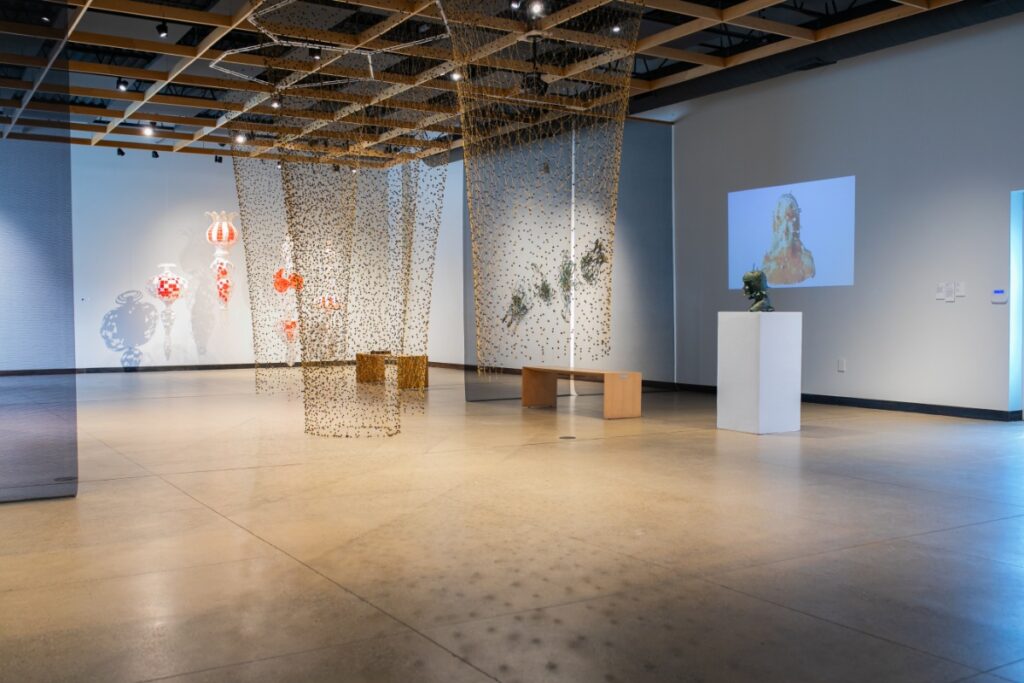
Founded in 1971, Contemporary Craft is one of the oldest craft institutions in the United States, integrating exhibitions, workshops and retail all under one roof. Its galleries present cutting‑edge work in wood, metal, fiber, clay and glass; its studios invite the public to create their own work, tearing down the barrier between artists and audiences.
Since Rearick’s return, the organization has undergone a dramatic expansion. Responding to overwhelming demand for hands-on learning, Contemporary Craft has more than doubled its space with a new location. The expansion has allowed the organization to reintroduce a wood studio, create two metal studios, establish a dedicated fiber space with a couple of dozen looms, add papermaking facilities and (for the first time in its history) open a blacksmithing studio.
Just as important, the expansion has enabled Contemporary Craft to purchase a nearby house, providing visiting artists with a place to live during their residencies. They also have access to a brand new, dedicated professional studio space filled with light and storage. “So much gratitude goes out to the first artists — because they put up with a lot,” Rearick recalls. “They had these little closets where they made work.”
Building a Stronger Creative Economy in Pittsburgh
For Rearick, the mission is deeply personal. She understands craft as a language of resilience, a means by which individuals and communities express their stories, struggles and aspirations. “What people don’t know is that there are so many talented craft artists [in Pittsburgh],” Rearick says, “making work and showing it internationally and globally.”
The “Pittsburgh IS Craft” initiative isn’t mere marketing, Rearick says; she fully believes in an ambitious plan to “ultimately grow the economic ecosystem” in Pittsburgh by joining forces with complementary organizations (also including Handmade Arcade, the Greater Pittsburgh Arts Council and others).
Rearick is looking forward to the possibility of a craft district along Butler Street or Penn Avenue in Lawrenceville — a part of the city where studios, retail spaces, public art and everyday life intersect. “How can we start having these points — craft, really good food, maybe a good shoe store, craft — along these two streets?” With support from neighborhood organizations and an advisory committee, the long ‑term goal is to create affordable pathways for artists to live, work and sell within the city.
Expanding Access and Opportunities for Artists
This vision also focuses on inclusivity. Rearick is aware of the challenges of gaining access in a field historically shaped by privilege and gatekeeping. Her hope is that open calls, intentional curation and funding opportunities designed to support artists with rent for retail spaces will help open doors.
An artist herself, Rearick enjoys the tactile world of making through ceramics, textiles or mixed media. These days, she doesn’t get much time to create in the studio. “My medium is creating community now,” she says. “That’s why ‘Pittsburgh IS Craft’ is so important to me.”
Story by Kahmeela Adams
Photos by Laura Petrilla