
The bustle of modern life mingles with the rhythms of the past as shining new developments rise beside century-old landmarks.
Shifts and Changes in Pittsburgh’s Enduring East End Neighborhoods
On a spring morning, sunlight glints off a glassy new office building at the corner of Penn and Highland avenues in Pittsburgh’s East End. Traffic pauses as a Pittsburgh Regional Transit bus slows to a stop, allowing commuters to spill onto the sidewalk. Across the street, the Gothic spire of East Liberty Presbyterian Church casts a familiar shadow, its stonework weathered by a century of seasons. A few early patrons linger by a coffee cart outside a renovated storefront.
The East End is, at once, a former streetcar suburb, a resurgent urban center, and a casualty of mid-century urban renewal. It is a mosaic of immigrant enclaves and — now — a test case for tech-fueled urban reinvention.
When Did the East End Notability?
The roots of this part of Pittsburgh’s urban footprint lie in the late 19th and early 20th centuries, when electric streetcars expanded Pittsburgh’s reach and turned neighborhoods like East Liberty, Shadyside, Squirrel Hill, and Point Breeze into desirable, walkable enclaves. As trolleys clattered along Penn and Fifth avenues, residential districts blossomed. Industrial magnates including Carnegie, Frick, Mellon, Heinz, and Westinghouse built substantial homes in Shadyside and Point Breeze, seeking refuge from the mills while remaining close to Downtown enterprises.
By 1900, the East End reputedly contained the wealthiest neighborhood in the world, with residents said to control 40 percent of the nation’s assets. Commercial life clustered where streetcars stopped — at Forbes and Murray in Squirrel Hill, and Walnut and Ellsworth in Shadyside. These intersections became corridors of shops, theaters, and cafes, and they still add to the East End’s texture today. Growth produced interconnected neighborhoods — elite enclaves, middle-class homes, and vibrant immigrant communities — linked by transit and economic opportunity.
The Up and Down Changes
By the 1950s, however, that system began to unravel. Automobile culture and suburban sprawl undercut streetcar suburbs nationwide. East Liberty, once a thriving shopping and transit hub, became ground zero for Pittsburgh’s ill-fated urban renewal efforts in the 1960s. Historic buildings were razed, streets were severed, and high-rise housing towers were erected in their place.
Change continued throughout the remainder of the 20th century. For Mikey Hood, a Pittsburgh native who grew up in Lincoln-Lemington and now works as a television host at KDKA, those changes were lived. “East Liberty used to mean being able to run an errand without it becoming a production,” Hood says. “You could walk Penn Avenue, go to the grocery store, stop into a few shops and you knew who owned them. People said hello. You felt like you belonged there.”
Disinvestment spread unevenly. By century’s end, the East End had become a patchwork — affluent blocks beside hollowed-out streets, scars of failed redevelopment alongside pockets of stability. Still, through decades of disruption, much of the East End’s soul — parks, neighborhood anchors, human-scaled architecture — endured.
Green-spaces and Community Buildings
Squirrel Hill and Point Breeze are bordered by two of Pittsburgh’s largest urban oases: Schenley Park to the west and Frick Park to the east. Frick Park, a 644-acre woodland donated by Henry Clay Frick and opened in 1927, stretches from Point Breeze into Squirrel Hill. Institutions like East Liberty Presbyterian Church, Carnegie Library branches, the Kelly Strayhorn Theater, and the Jewish Community Center offered cultural continuity even as neighborhoods shifted. “When I take my son to Frick Park or the Carnegie Museum and he gets excited in the same places I did, it reminds me that not everything has to be replaced to move forward,” Hood says. “Things change. But the fact that those places are still there — that matters.”
The seeds of today’s rebirth come from the early 2000s. Along Penn Avenue, particularly in East Liberty and at Bakery Square, abandoned factories and vacant lots gave way to offices, apartments, and retail. A turning point arrived in 2010, when Google opened a large office in the redeveloped Bakery Square complex, a former Nabisco baking plant. Its presence expanded quickly, drawing other technology and advanced-industry firms.
Cutting Edge in the East End
Only 5 miles from Downtown, the East End is now a tech corridor. Companies like Google, Philips, and UPMC Enterprises operate alongside startups and research labs drawn by proximity to universities, hospitals, and transit. Penn Avenue between Shady and Fifth has been dubbed “AI Avenue” for its concentration of machine learning and robotics companies. In 2016, Duolingo moved its headquarters to East Liberty, further cementing the area’s role in the city’s tech ecosystem.
For real estate developer and restaurateur Herky Pollock, who grew up in the East End, the moment is ongoing. “We’re in the boom,” he says. “The city’s growth engines — universities, health care, high tech, financial services — are largely rooted in the East End, and that continues to accelerate.”
Hand in hand with tech growth, the East End is experiencing a surge of mixed-use development. The clearest symbol is The Meridian at Penn and Shady, long described as East Liberty’s “main and main.” Planned as a mix of grocery, retail, dining, and 231 apartments above, the project reflects a new development template.
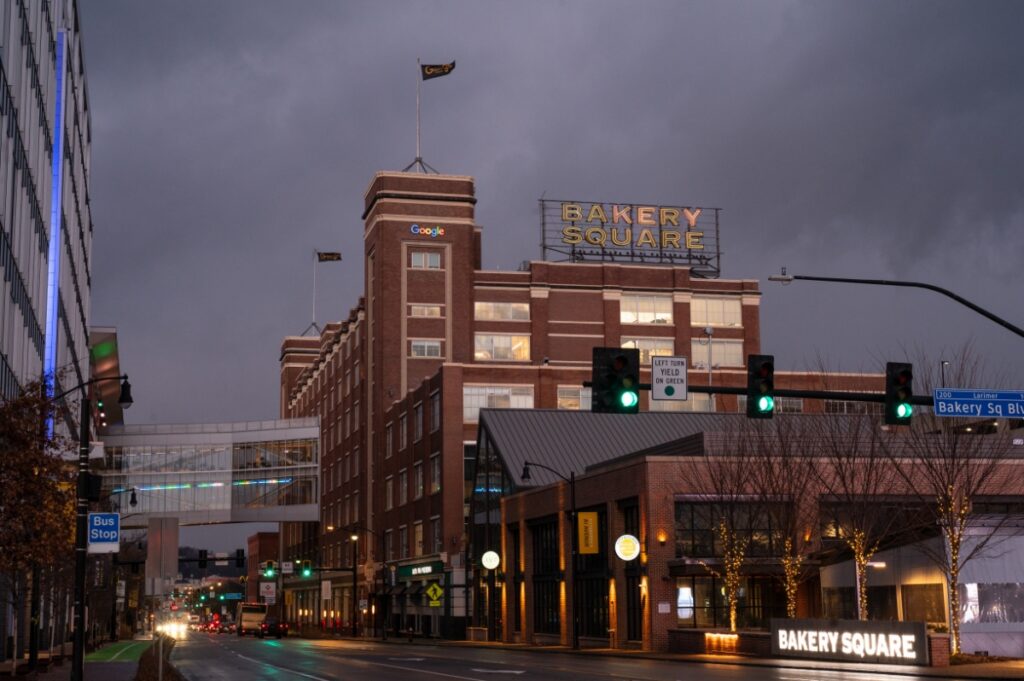
Bakery Square on Penn Avenue
Bakery Square is expanding again. A city-approved plan finalized in 2025 opens the door to a roughly $500 million, 14-acre extension into Larimer and East Liberty, pairing new housing and offices with a proposed land bridge over the Martin Luther King Jr. East Busway — an attempt to undo decades of physical separation by pulling people back to the street. While Bakery Square has altered those plans to de-emphasize office space, the development continues.
“Everything starts with a strong residential foundation,” Pollock says. “People want to live close to these drivers, and that proximity fuels everything else.”
Chef and restaurateur Jamilka Borges, co-owner of Lilith, has experienced the change from inside East End dining rooms and kitchens. “I remember when people were afraid to go through East Liberty,” Borges says. “Restaurants helped bring people back. But not all of that change was done well, and displacement has absolutely been part of the story.”
In many ways, the East End now represents a paradox. It is both the most forward-looking part of the city and the one most tethered to its past.
Walnut Street, Squirrel Hill, and Point Breeze as Local Destinations
Walk down Walnut Street in Shadyside, where designer boutiques line the sidewalks and couples sip Aperol spritzes on bistro patios, and the scene could pass for an upscale neighborhood in Boston or Dallas. The shopping strip remains lined with boutique clothing stores, high-end chains, and specialty shops, though the roster has evolved. Where Gap and Banana Republic once dominated in the 1980s, Apple and Warby Parker now anchor the street. Longtime fixtures like Casbah and breakfast institution Pamela’s Diner remain.
To the east, Squirrel Hill is dense, walkable, and deeply lived-in. The Manor Theatre still glows beneath its Art Deco marquee. Line-out-the-door bagel shops like Pigeon Bagels hold their ground as new cafes open across the street. The neighborhood remains one of Pittsburgh’s most demographically diverse, home to Orthodox Jewish families, Asian students, immigrant business owners, and retirees who have lived near Murray Avenue for decades.
Adjacent Point Breeze is among the East End’s most elegant neighborhoods, anchored by Frick Park and long-held homes. North of it, Highland Park centers on its reservoir and green space. Its Victorian streets are marked more by continuity than change. Neighborhoods like Friendship, North Point Breeze, and Morningside are small but essential, binding the East End together.
Neighborhoods Fueled by Art
If daylight hours showcase a tech-fueled rebirth, evenings belong to the region’s arts and culinary life. On the first Friday of each month, creative energy pulses along Penn Avenue through Garfield and Bloomfield during Unblurred, the city’s longest-running art crawl. Sidewalks teem with people ducking into galleries and pop-up studios, browsing vendors’ wares. The air carries mixed aromas of food truck fare and roasted coffee. A band might jam from a porch turned stage as a dance circle forms nearby.
For Steph Neary, an artist who lives and works in Garfield, that spirit recalls an earlier version of the East End. “When I think back to the East End in the late 2000s and early 2010s, what stands out most is that there were still spaces where people could fail without it becoming a financial crisis,” Neary says. “Making bad art on the way to making good art was not just allowed, it was essential.”
That kind of freedom, she believes, has become harder to sustain. “Now, landlords and venues charge prices that don’t allow for failure at all,” she says.
Still, Neary sees potential ahead. “I hope the next chapter of the East End makes room again for low-stakes creativity,” she says. “Spaces without prestige. Rooms where people can sit with their friends and watch what happens.”
The East End Eats
That same tension — between refinement and experimentation — now shapes the East End’s nightlife. In East Liberty, Palm Palm and Hey Babe sit around the corner from one another, a coastal-leaning restaurant and a cocktail-forward lounge sharing a block and a crowd. In Squirrel Hill, kosher barbecue, Asian hot pot, bubble tea, and babka operate within a few dense blocks of one another.
Borges points to the range as evidence of the neighborhood itself.
“There have always been Asian restaurants in Squirrel Hill, but now you’re seeing a much wider range of cuisines done really well,” Borges says. “That reflects who actually lives there now. That kind of representation on the plate matters.”
Growing in Tradition and Modernity
In Bloomfield, long known as Pittsburgh’s Little Italy, the old and new commingle in especially delicious ways. Liberty Avenue remains dotted with traditional stalwarts, yet Bloomfield today is far from a monoculture of marinara. “Bloomfield was defined for decades by a single Italian-American story,” Borges says. “Look at Fet-Fisk, Apteka, Brothmonger. The neighborhood is opening itself up, and that’s what makes it feel alive again.”
Within a few short blocks, diners move from Vietnamese pho at Tram’s Kitchen to Indian curries — and then on to Thai desserts. The range would have been unthinkable half a century ago. Where Lombardozzi’s Restaurant held court for 50 years, Fet-Fisk now anchors the block. The Nordic-inspired restaurant has earned James Beard nominations and national attention; tin ceilings and a wooden bar remain, preserving the room’s old-school warmth even as the menu signals a new era.
As the East End continues to grow and change, Pollock hopes its underlying values remain intact. “The East End has always been a true melting pot, sometimes block by block. That inclusivity is foundational. Treating others the way we want to be treated is the foundation of the East End and of Pittsburgh as a whole.”
Story by Aakanksha Agarwal
Photography by Justin Merriman