
For more than 50 years the Pittsburgh Camerata, a vocal ensemble, has worked to blend voices into a sum greater than its parts.
Founded in 1974 by a group of friends who wanted to sing historically informed performances of early music, the Pittsburgh Camerata has evolved over the last 50 years to become a gem of the Pittsburgh cultural scene.
With Shadyside Presbyterian Church as its home, the 24-member professional group, bound by a shared passion for choral music, has raised its collective voices in harmony, carving out a well-defined niche in the art of ensemble singing.
The Evolution of Ensemble Singing and Artistic Leadership
The word “camerata” comes from the Italian, meaning “chamber.” It is generally a small group of musicians who meet to discuss, perform, or create art — especially vocal or instrumental music.
“People have been singing since the beginning of time, and so ensemble singing goes back to the beginning of mankind. It began to evolve in the Western Hemisphere in the church, starting out as unison chant, went into two, three, four parts and has become what we know it today,” said Mark A. Anderson, Pittsburgh Camerata’s artistic director.
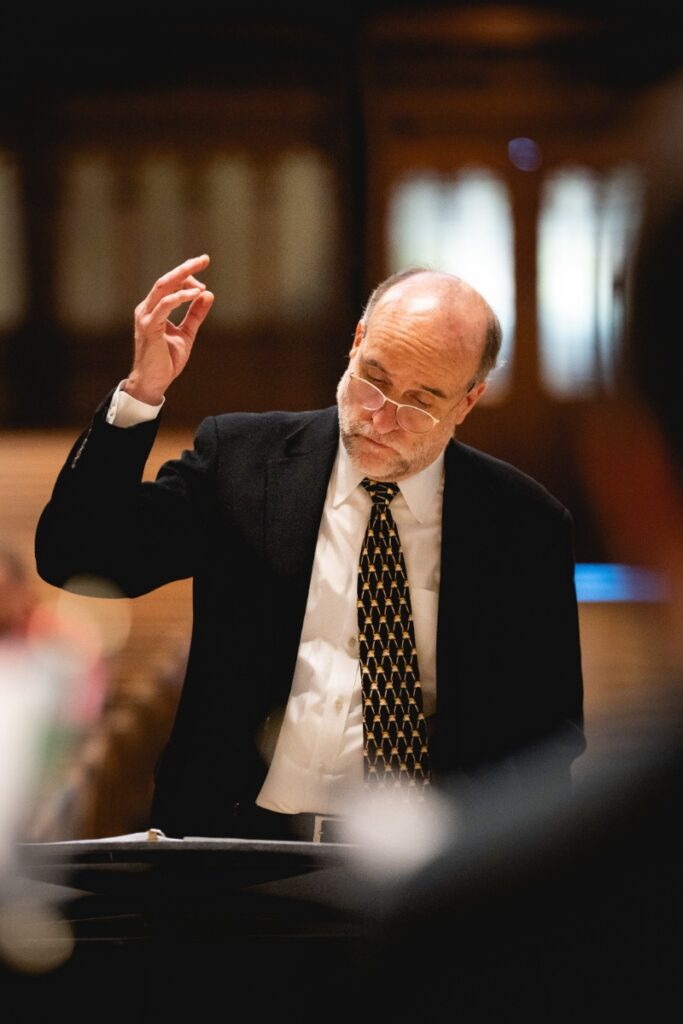
Anderson also serves as director of music ministry at Shadyside Presbyterian Church as well as having occupied other positions of prominence in the world of music. He is an award-winning composer of choral compositions and hymns.
Anderson came on as Pittsburgh Camerata’s artistic director in 2016 following the retirement of Rebecca Rollett, who led the group for 18 years. Under her leadership, the group began to morph from all volunteers to paid professionals.
While the Pittsburgh Camerata’s focus is on music by a choir, the group sings both a cappella as well as accompanied music; occasionally, the group performs with small orchestras. All vocal parts — soprano, alto, tenor, and bass — come into play.
Performances That Support Community Engagement, and Musical Diversity
Though most performances are at its Shadyside Presbyterian Church home, the group performs in other venues throughout the city, including Heinz Chapel, churches, and universities; occasionally, it will travel outside the city for concerts. “We’re always looking to find venues outside of churches because we are not a religious group,” he says. In an effort to build community and support younger singers, the Camerata sometimes performs with other groups, such as hosting high school or middle school guest choirs.
Anderson spends countless hours fine-tuning each season’s repertoire of choral works, ranging from Renaissance-era and Baroque music to contemporary, newly commissioned works. “I continued Rebecca’s push to do more contemporary repertoire,” he says.
As the organization moves into its next 50 years, Anderson would like to focus more on newly commissioned music written specifically for the Pittsburgh Camerata, while still performing old standards. “There are so many wonderful living composers right now, and young ones,” he says. “They deserve to be heard.”
New Music for a Future Legacy
Some personal favorites include Michael Markowski, who wrote two pieces for the Pittsburgh Camerata and is writing a third for this year. “His compositions, at least for me, have helped shape a major part of the identity for our ensemble,” says Anderson.
A sign of a healthy ensemble chamber group, he explains, is one whose sound and character continues to evolve — it can’t stay stagnant.
“The group has changed every year I’ve been a part of it. I would expect that someday when I am done and someone else picks it up, it will go in a different direction.”
Annually, Anderson travels to a convention for ensemble groups and checks out what’s new in the world of recent compositions of choral music. “I come back with a small suitcase of music every year,” he says, noting that he has more than 8,000 individual choral pieces on his shelves.
The Pittsburgh Camerata’s concert season begins in the fall and continues into early summer, with each program representing a different theme.
Programs Take Careful Preparation
To prepare for each program, Anderson pores through 150 to 200 pieces before whittling them down to 10 or 11 selections. Once he figures out what texts complement each other, he weaves together a program. Previous themes have included women composers, music of the spheres, a program about animals, and one about memories and remembrances.
And for its 50th anniversary gala last year, held at the Pittsburgh Golf Club, the group chose a Pittsburgh theme — one that focused on music from the Mister Rogers Songbook.
This 19- song book had not been previously arranged for choral ensembles. Anderson, who grew up in Montana, did not know of Fred Rogers until he was an adult. But when he started reading the texts of Rogers’ songs, he realized “they’re not just for kids. They are every bit as important today — if not more so.”
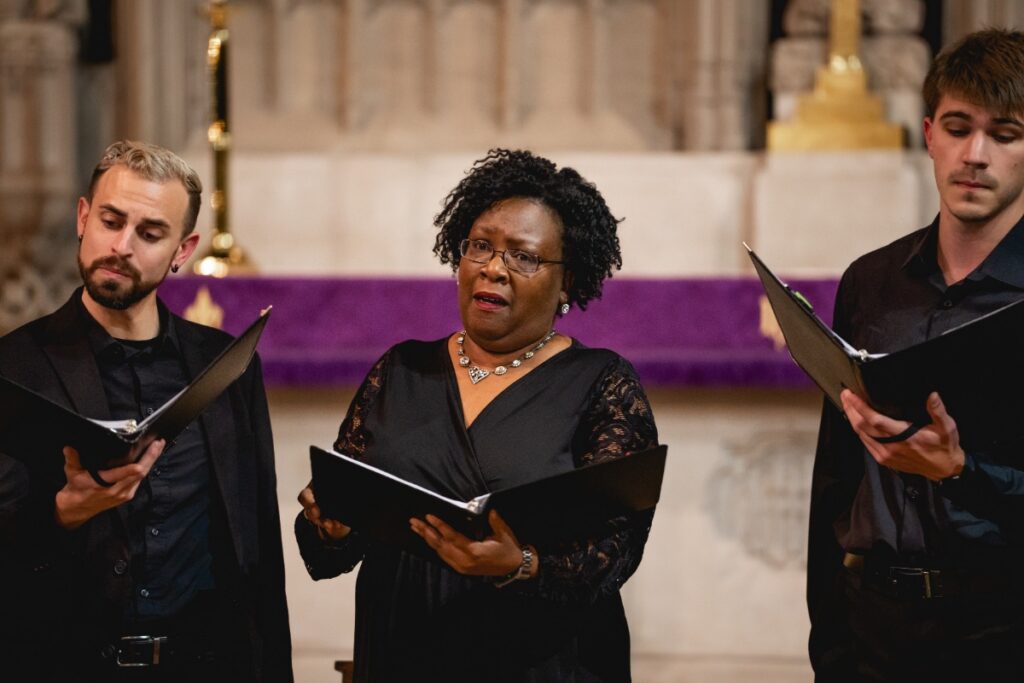
The evening was a tribute to a man (and ordained Presbyterian minister) who is beloved in our own neighborhood — as well as being a reminder of the simple, yet profound, power of music.
“We wanted to celebrate a Pittsburgh institution and wanted to celebrate it with someone who everyone knows and recognizes as Pittsburgh,” he says. “It was so outside of our wheelhouse because we do serious, esoteric choral music. It was a really moving experience for all of us.”
The Camerata Cabaret held in October, a fundraiser at the Pittsburgh Golf Club featuring Broadway and classic cabaret music, includes songs made famous by such Pittsburgh-connected musicians as Bobby Vinton, Lena Horne, and Shirley Jones. Subscribers and individual ticket holders also look forward to the annual Christmas With the Camerata concert.
It Starts With Great Leadership
For Jane Potter Baumer, Anderson’s leadership hit all the right notes, which is why she joined the board in 2018 after singing with the Pittsburgh Camerata between 2005 and 2023. “I saw in my very first rehearsal that Mark’s ability to bring phrases alive moved even very experienced musicians.”
She knew she wanted to be a “part of making sure that the Camerata was here for many years to come.” Eventually, Baumer says, “I realized that the best way to do that was to join the board.” She is now in her fifth year as board president.
Baumer, who had a great deal of experience singing with other professional choirs prior to joining the Camerata, believes that the quality of the singers is what makes the group stand out.
“They are the best. These people are highly trained, passionate about vocal music, and they can do whatever an artistic director asks of them regarding tone quality, pitch, rhythmic precision, artistic expression,” she says. “They are extremely devoted to this art form. All of our singers are soloists in their own right but love to perform in an ensemble.”
When one sings in an ensemble, she explains, there is a shared humanity that is unattainable in any other way. “Science says when we sing together, our heart rates synchronize, our breathing slows, we become more empathetic and more aware of our emotional state and the states of those around us.”
“With the voice, there is no instrument between you and the audience — it’s a direct communication of the voice you are born with that is uniquely yours with the people who are listening to you,” Baumer says. “It’s the ultimate synchronicity of mind, body, and spirit.”
Story by Hilary Daninhirsch